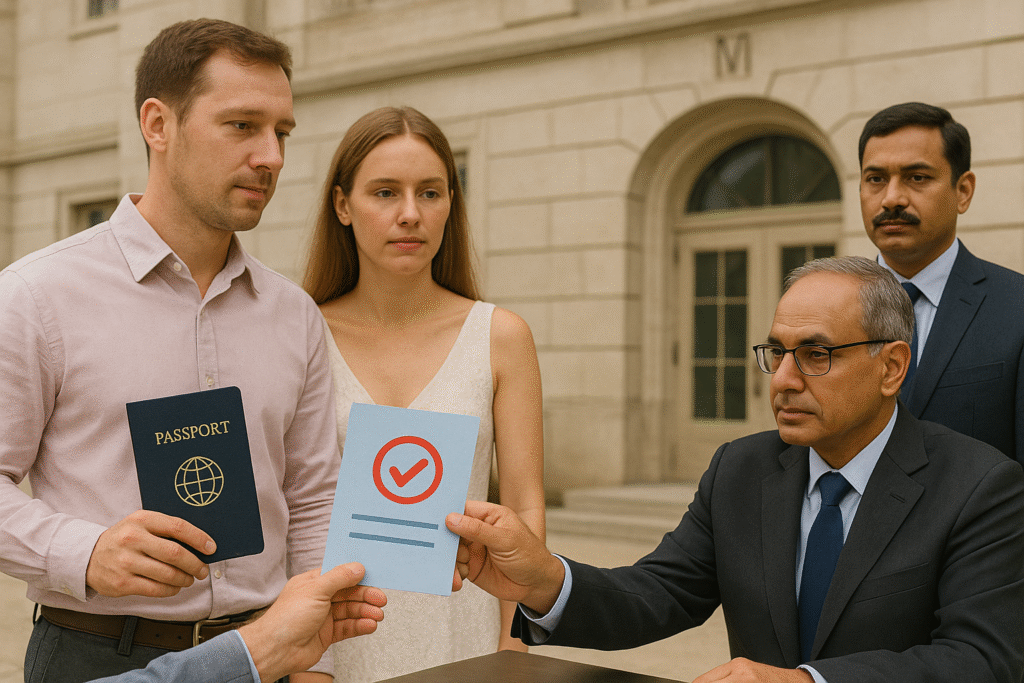
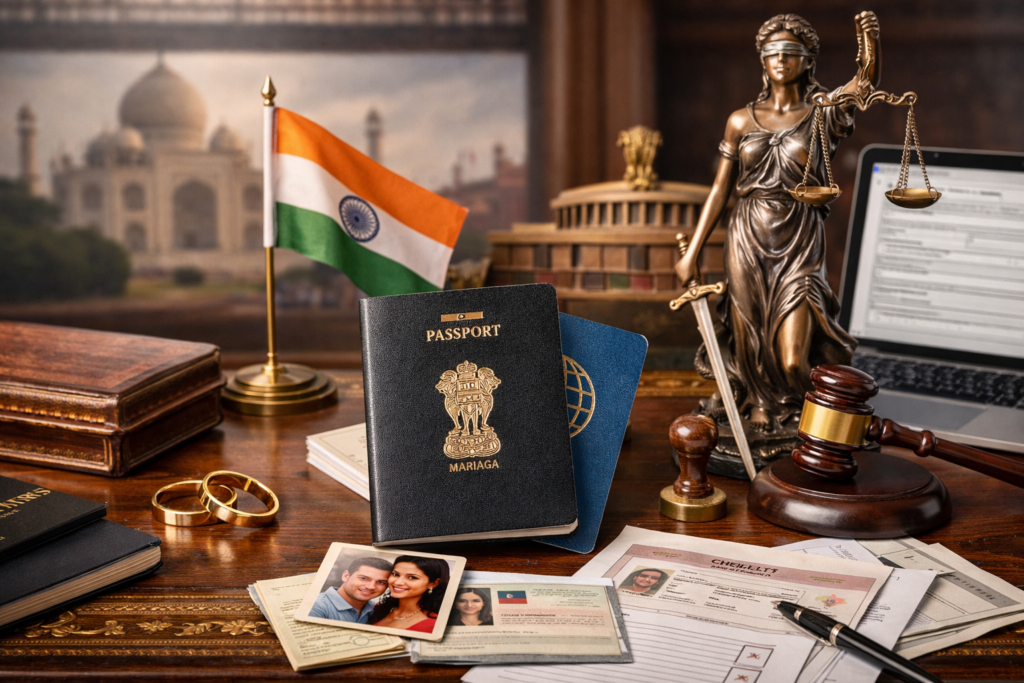
Indian citizenship by registration for a foreign spouse is not a quick or automatic process, even after marriage to an Indian citizen, and this is the most important point for foreign spouse to understand at the outset. In India, citizenship is treated as a serious legal status, not a marital benefit, which is why the law follows a highly regulated and carefully controlled system. Simply put, marriage only makes a foreign spouse eligible to apply in the future, but the final decision depends on long-term lawful residence in India, strict visa compliance, clean immigration history, security clearance, and complete government satisfaction. Therefore, Indian citizenship by registration is legally possible for a foreign spouse, but it is a long-term, document-heavy, and high-scrutiny process that demands patience, accuracy, and strict compliance at every stage.
Which Indian Laws Govern Citizenship for Foreign Spouses?
Indian citizenship for a foreign spouse is governed by a clear statutory framework, and it is important for foreign spouse/applicants to understand that this process is law-driven, not discretionary at the initial stage. The primary law is the
Citizenship Act, 1955, which lays down who can become an Indian citizen and under what conditions. This Act is implemented through the Citizenship Rules, 2009, which explain the procedure, documents, forms, and verifications required. The entire citizenship process is administered and finally decided by the Ministry of Home Affairs (MHA), Government of India.
For foreign spouses, the applicable route is Citizenship by Registration under Section 5(1)(c), which states “a person who is married to a citizen of India and is ordinarily resident in India for seven years before making an application for registration.”
It specifically allows a foreign national married to an Indian citizen to apply for Indian citizenship after fulfilling the mandatory residence period and legal conditions, making it clear that citizenship is granted by law and registration, not automatically by marriage.
Eligibility Criteria for Indian Citizenship by Registration for Foreign Spouses
A foreign national can apply for Indian citizenship by registration only if every legal condition is fully satisfied, and there is no flexibility or relaxation in these requirements. The essential conditions are:
- Legally married to an Indian citizen
- Marriage is valid, registered, genuine, and subsisting
- Ordinarily resident in India for 7 years including 12 continuous months immediately before application, and 6 years residence in the preceding 8 years
Further, the applicant must have stayed in India only on valid visas throughout this entire period, without any overstay, violation, or illegal stay, as immigration compliance is closely examined. The foreign spouse must also be a person of good character, meaning there should be no criminal cases, adverse police reports, or security concerns, and must clearly demonstrate an intention to permanently reside in India and make India their long-term home. Importantly, even when all these conditions are met, Indian citizenship is not granted as a matter of right, and the final decision remains discretionary with the Government of India, which may approve or refuse the application based on overall satisfaction and public interest considerations.
Residence and Visa Requirements for Foreign Spouses Applying for Indian Citizenship
Residence and visa compliance is the most important and sensitive part of Indian citizenship by registration, and most applications fail due to mistakes in this area. Indian authorities do not look only at the number of years spent in India; instead, they closely examine how and on what visa the foreign spouse stayed in India during the entire qualifying period. The accepted legal path usually begins with an Entry Visa (X Visa) issued on the basis of marriage to an Indian citizen, followed by conversion to a Long-Term Visa (LTV) after verification. Thereafter, the foreign spouse must ensure timely and continuous visa extensions without any gap and complete mandatory registration and updates with the Foreigners Regional Registration Office (FRRO) throughout the stay.
Important Legal Nuances Foreign Spouses Must Know Before Applying
It is crucial to understand that tourist visas are not counted as lawful residence for citizenship purposes, no matter how long the stay may be. Even a single instance of overstay, visa misuse, or immigration violation can invalidate the entire seven-year residence period, forcing the applicant to restart the eligibility timeline. Similarly, long or frequent absences from India may break the requirement of continuous residence and can raise doubts about the intention to permanently settle in India. For this reason, FRRO records are treated as primary and decisive evidence by the government, and any inconsistency between visa history, FRRO data, and residence claims can seriously damage or permanently defeat a citizenship application.
Online Filing Procedure (Step-by-Step)
All applications for Indian citizenship by registration are filed online only, and there is no offline or manual submission option. There are three essential steps online filing which are:
Step 1: the foreign spouse must apply through the official citizenship portal of the Ministry of Home Affairs (MHA) and carefully select Citizenship by Registration – Section 5(1)(c), which is the specific category meant for spouses of Indian citizens. At this stage, the applicant must fill in personal details, marriage information, visa history, and complete residence details exactly as they appear in official records, because even small mistakes can raise objections later.
Step 2: The applicant must upload scanned copies of all required documents in the prescribed size and format, ensuring that names, dates, addresses, and passport details are fully consistent across every document, as any mismatch or missing document can lead to delays, clarification notices, or rejection.
Step 3: After reviewing the entire application carefully, the applicant must pay the prescribed government fee online and submit the application electronically. Once submitted, the application enters the government verification process, and changes are usually not allowed, which is why accuracy and completeness at the filing stage are extremely important.
It is strongly advisable for a foreign spouse to adopt a meticulous, cautious, and well-planned approach when proceeding with Indian citizenship by registration, as even minor errors or omissions can lead to serious legal complications, prolonged delays, or outright rejection of the application. Once an application is rejected, the consequences can extend beyond citizenship and may affect future visa renewals, long-term stay in India, or immigration status, making careful preparation and full compliance essential at every stage of the process.
Documents Required Checklist
When applying for Indian citizenship by registration, submitting the correct documents in proper order is absolutely critical, as the entire decision depends on documentary proof. The required mandatory documents are as follow:
Personal and Identity Verification
The foreign spouse must provide a valid foreign passport with copies of all pages, a birth certificate, and current visa documents, including the Long-Term Visa (LTV) and related approvals. These documents establish who you are and confirm that you are legally present in India.
Marriage and Spouse-Related Proof
Authorities require a legally registered marriage certificate, along with the Indian spouse’s passport and Aadhaar, and clear proof that the spouse is an Indian citizen by birth or by registration, since citizenship through marriage is possible only when the spouse is lawfully Indian.
Residence proof
It is one of the most important sections and is examined very closely. This includes complete registration records and stay history with the Foreigners Regional Registration Office (FRRO), all visa extension records, and supporting documents such as utility bills, rental agreements, or official address verification certificates to show continuous and lawful residence in India.
Character and Legal Compliance
The applicant must submit police verification reports, an affidavit declaring good character, a formal declaration of allegiance to India, and a clear declaration stating the intention to permanently reside in India.
Finally, It is extremely important to ensure that names, dates, addresses, and spellings match across all documents, because any mismatch or inconsistency must be properly explained through sworn affidavits, failing which the application may face objections, delays, or rejection.
Verification & Scrutiny Stages: What Happens After Filing
After the online application for Indian citizenship by registration is submitted, the process does not end there; instead, it enters multiple layers of government verification, which is the main reason the procedure takes considerable time. The essential procedures are:
- The application is sent for local police verification, where authorities verify the applicant’s identity, residence, conduct, and marital status at the local level.
- There is a detailed review by immigration authorities and the Foreigners Regional Registration Office (FRRO), who examine the applicant’s visa history, stay records, and overall immigration compliance. After this,
- The file is forwarded to the State Government, which reviews the case and gives its recommendation based on local reports and records. The application then undergoes central-level security and intelligence clearance, where national security aspects are assessed.
Finally, based on all these reports and clearances, the Ministry of Home Affairs (MHA) takes the final decision on granting or refusing citizenship. Because each stage involves independent scrutiny and inter-departmental coordination, this multi-tiered process naturally takes time and requires patience from the applicant.
Processing Timeline
When planning Indian citizenship by registration, foreign spouses must have realistic expectations about time, as this is a long-term legal process. After submission of the application, the post-filing processing period usually takes between 12 to 36 months, and in some cases, it may take even longer depending on the complexity of the case. Delays are quite common and should be expected, as the application often gets held up due to security and intelligence clearances, requests for clarifications or additional documents, and the time taken for communication and recommendations between local authorities, the State Government, and the Central Government.
Therefore, patience is essential, and applicants should plan their stay, visas, and personal commitments keeping this extended timeline in mind.
Conclusion
Indian citizenship by registration for a foreign spouse is a long-term, compliance-driven, and highly discretionary process under Indian law. While marriage to an Indian citizen opens the door to eligibility, it is ultimately continuous lawful residence, strict visa discipline, complete and accurate documentation, and overall government satisfaction that determine the final outcome. Because the process involves multiple levels of scrutiny and carries significant legal consequences if mishandled, it requires patience, precision, and careful planning. For most foreign spouses, obtaining an OCI (Overseas Citizen of India) card is the more practical, faster, and less risky solution for long-term stay in India, while Indian citizenship should be pursued only after thoughtful legal evaluation and with a well-planned strategy.
It is strongly advised to seek assistance from a qualified legal professional when applying for Indian citizenship, as even minor mistakes can lead to delays or rejection. You may contact us for personalized legal guidance and professional support tailored to your specific situation.
Subscribe to stay updated with the latest legal developments, immigration rules, and practical guidance for foreign nationals.