
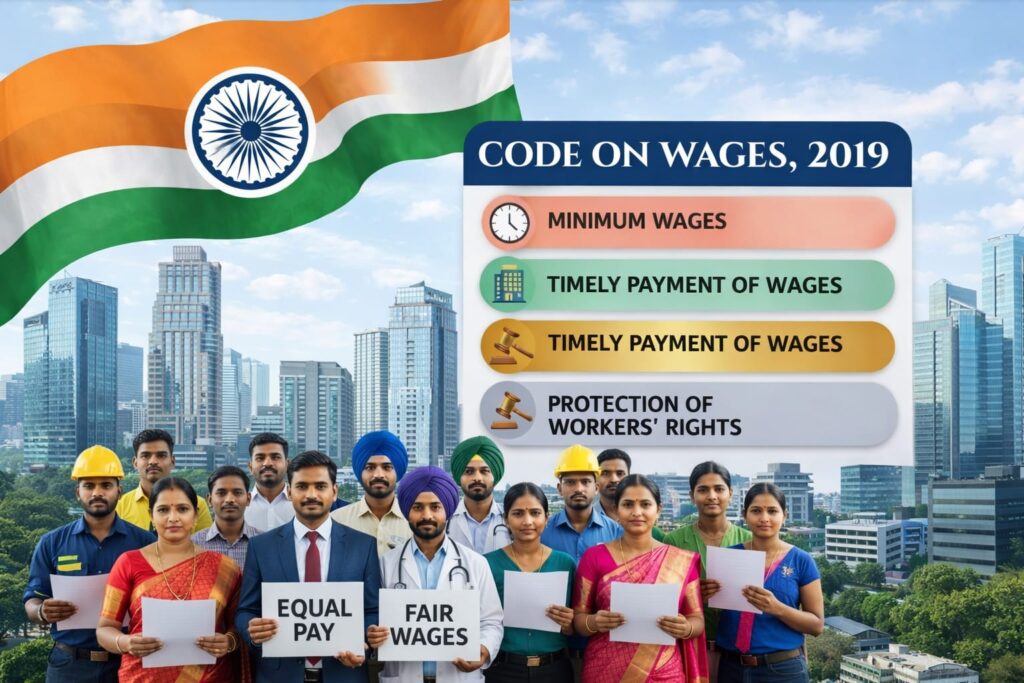
The Code on Wages, 2019 is one of the four major labour law/code reforms introduced by the Government of India. It amalgamates and replaces four earlier laws relating to wages and payment of wages.
These earlier laws were:
- Payment of Wages Act, 1936
- Minimum Wages Act, 1948
- Payment of Bonus Act, 1965
- Equal Remuneration Act, 1976
The purpose of this Code is to simplify wage laws, protect workers’ rights, and make compliance easier for employers. It ensures that workers receive minimum wages, equal pay for equal work, and timely payment of wages. The Code also promotes fair workplaces, economic growth, and better labour welfare across India.
Objectives of the Code on Wages
The Code on Wages, 2019 was introduced to create a uniform and transparent wage system across India. The main objective of the Code is to simplify wage-related laws while ensuring fair treatment and protection for workers.
The Code aims to achieve the following:
- Ensure minimum wages for all employees, including those working in both the organised and unorganised sectors.
- Guarantee timely payment of wages so that employees receive their earnings without unnecessary delays.
- Prevent gender discrimination in wages and recruitment by ensuring equal pay for the same or similar work.
- Simplify compliance for businesses by consolidating multiple wage-related laws into a single legislation.
- Strengthen worker welfare and improve labour productivity by providing fair and transparent wage practices.
By ensuring fair wages, transparency, and equal treatment, the Code on Wages helps improve working conditions, promote workplace equality, and support sustainable economic growth.
1. Minimum Wages (Section 5)
every employer is required to pay employees at least the minimum wages notified by the appropriate government. The appropriate government may be either the Central Government or the State Government, depending on the type of employment and industry.
Categories of Workers
Minimum wages are notified for different categories of workers based on their skill level, such as:
- Unskilled workers
• Semi-skilled workers
• Skilled workers
• Highly skilled workers
Key Factors Affecting Minimum Wage Rates
The minimum wage rate may vary depending on several factors, including:
- Nature of the industry or type of employment
• Skill level of the worker
• Geographical location or region
Mandatory Compliance
Employers are legally required to pay wages not less than the minimum wage notified by the government. Paying wages below the prescribed minimum wage is considered a violation of the law and may attract penalties.
This provision ensures that workers receive fair compensation for their labour and are protected from exploitation.
2. No Gender Discrimination (Section 3)
Employers are strictly prohibited from discriminating against employees on the basis of gender in matters related to wages and recruitment.
Equal Pay for Equal Work
Employers must ensure that men and women receive equal wages for performing the same work or work of a similar nature. The principle of equal pay helps ensure fairness and prevents wage discrimination in the workplace.
Non-Discrimination in Recruitment
Employers must also ensure that no discrimination is made during recruitment or employment decisions based on gender, except in cases where the nature of work legally restricts employment of a particular gender.
This provision promotes:
- Workplace equality
• Fair employment opportunities
• Elimination of gender-based wage discrimination
By ensuring equal pay and fair hiring practices, the Code supports a more inclusive and equitable work environment.
3. Wage Period and Payment of Wages (Section 6)
Every employer must fix a wage period, which may be:
- Daily
- Weekly
- Fortnightly
- Monthly
Wages must be paid within the prescribed time limits.
Payment timelines
- Daily wage workers – Wages must be paid at the end of the working day
- Weekly wage workers – Wages must be paid on the last working day of the week
- Fortnightly wage workers – Wages must be paid within two days after the end of the fortnight
- Monthly wage workers – Wages must be paid before the 7th day of the next month
This rule ensures timely payment of wages to employees promoting financial security and transparency in employment.
4. Payment of Wages When an Employee Leaves the Job (Section 17)
Employers must ensure that all wages due to an employee are paid promptly when the employee leaves the job.
This requirement applies when an employee’s employment ends due to:
- Resignation
• Termination of employment
• Dismissal by the employer
In such cases, the employer must pay all outstanding wages to the employee within two working days from the date of separation.
This rule ensures that employees receive their final wages without unnecessary delay, and it prevents employers from withholding or postponing salary payments after employment ends.
5. Working Hours and Overtime (Section 14)
Employers must comply with the working hours and rest periods prescribed by the appropriate government through rules or notifications.
Employees are expected to work only within the normal working hours fixed under the applicable labour laws or rules.
Overtime Wages
If an employee works beyond the normal working hours, the employer is required to pay overtime wages.
The overtime rate must be at least twice the employee’s normal wage rate.
Example: If an employee earns ₹100 per hour, the overtime wage must be ₹200 per hour for every additional hour worked.
This provision ensures that employees:
- Are fairly compensated for extra work
• Are protected from excessive working hours without proper payment
• Work under regulated and humane working conditions.
6. Registers and Records (Sections 19, 21, and 50)
Every employer is required to maintain proper registers and records relating to employees and wage payments. Maintaining these records helps ensure transparency, accountability, and compliance with labour laws.
Registers to be Maintained
Employers must maintain the following registers in the prescribed format:
- Attendance Register or Muster Roll – Records the attendance and working days of employees.
- Wage Register – Contains details of wages paid to employees during each wage period.
- Overtime Register – Records the overtime hours worked by employees and the overtime wages paid.
- Register of Fines and Deductions – Maintains details of fines imposed and deductions made from employees’ wages.
Mode of Maintenance
These records may be maintained:
- In physical form (manual registers), or
- In electronic or digital form, as prescribed by the appropriate government.
Record Retention
All registers and records must be properly preserved for a minimum period of five years. Maintaining these records ensures proper documentation of wage payments, compliance with labour regulations, and easy verification during inspections by authorities.
7. Wage Slips for Employees
Every employer is required to issue wage slips to employees. A wage slip provides a clear record of the wages earned and any deductions made during the wage period.
The wage slip should contain the following details:
- Total wages earned during the wage period
• Details of deductions, if any
• Overtime payments, where applicable
• Net wages payable to the employee
Time of Issuance
The wage slip must be provided to the employee before or at the time of payment of wages. Issuing wage slips ensures transparency in wage payments, proper record-keeping, and awareness among employees regarding their earnings and deductions.
8. Information to be Displayed on the Notice Board (Section 50)
Every establishment is required to display certain important information on a notice board at the workplace. This ensures that employees are aware of their rights and employment conditions.
The notice must be displayed in:
- English
• Hindi
• The local language of the State where the establishment is located
The notice board must clearly display the following details:
- Minimum wage rates applicable to the employees
• Normal working hours
• Wage period (daily, weekly, fortnightly, or monthly)
• Date or schedule of wage payment
• Name and address of the Inspector-cum-Facilitator appointed under the Code
Displaying this information promotes transparency, awareness of employee rights, and compliance with labour regulations.
9. Authorised Deductions from Wages (Section 18)
Employers are not allowed to deduct any amount from an employee’s wages unless the deduction is specifically permitted by law. This provision protects workers from unfair or arbitrary wage deductions.
Permitted Deductions
The following deductions are allowed under the Code:
- Absence from duty – Deduction may be made for the period during which the employee was absent from work without authorisation.
- Damage or loss caused by the employee – If an employee causes damage or loss to the employer’s property due to negligence or misconduct, a deduction may be made after following the prescribed procedure.
- Recovery of loans or salary advances – Employers may deduct amounts for repayment of loans or advances previously given to the employee.
- Fines – Fines may be imposed for misconduct, but only after giving the employee an opportunity to explain or defend their actions.
- House accommodation – Deductions may be made for housing or accommodation provided by the employer.
- Amenities or services – Deductions may also be made for amenities or services provided by the employer, provided the employee has accepted such facilities.
Limit on Total Deductions
The total amount deducted from an employee’s wages must not exceed 50% of the wages during the wage period.
This rule ensures that employees receive a substantial portion of their wages and are protected from excessive deductions.
10. Bonus Provisions (Section 26)
Eligible employees are entitled to receive an annual bonus from their employer.
Eligibility for Bonus
An employee becomes eligible for bonus if:
- The employee earns wages within the wage limit prescribed by the appropriate government.
• The employee has worked for at least 30 days during the accounting year.
The accounting year generally begins on 1 April and ends on 31 March of the following year.
Bonus Rates
The bonus payable to eligible employees must fall within the following limits:
- Minimum Bonus: 8.33% of the annual wages earned by the employee.
- Maximum Bonus: 20% of the annual wages earned by the employee.
The exact amount of bonus may depend on the financial performance and profitability of the establishment, subject to the limits prescribed under the Code.
This provision ensures that employees receive a fair share in the organisation’s productivity and economic success, while also encouraging better performance and industrial harmony.
11. Penalties for Non-Compliance
The Code on Wages, 2019 prescribes penalties for employers who fail to comply with wage-related provisions. These penalties are intended to ensure that employers follow the law and protect workers’ rights.
a) Payment of Wages Less Than the Amount Due
If an employer pays wages less than the amount legally payable under the Code:
- First offence: Fine up to ₹50,000.
- Repeat offence within five years:
- Imprisonment for a term that may extend to three months, and
- Fine up to ₹1,00,000, or both.
b. Other Violations
If an employer fails to comply with other requirements under the Code, such as:
- Maintaining statutory registers
- Issuing wage slips
- Displaying required information on notice boards
- Following prescribed record-keeping rules
then the following penalties may apply:
- First offence: Fine up to ₹20,000.
- Repeat offence:
- Imprisonment for a term that may extend to one month, and
- Fine up to ₹40,000, or both.
These penalties encourage employers to strictly comply with wage laws and ensure fair treatment of workers.
Closing Insight
The Code on Wages, 2019 marks a significant step in the reform of India’s labour law framework by creating a unified and transparent system for wage regulation across the country. By consolidating multiple wage-related laws into a single comprehensive legislation, the Code simplifies compliance for employers while strengthening the protection of workers’ rights. It ensures that employees receive fair wages through the enforcement of minimum wage standards, guarantees equal pay for men and women performing the same or similar work, and mandates timely payment of wages to prevent delays or exploitation. The Code also provides clear rules regarding overtime payments, authorised deductions from wages, maintenance of records, and issuance of wage slips, thereby improving accountability and transparency in employment practices. Overall, by establishing uniform wage rules across industries and sectors, the Code on Wages promotes fair employment practices, enhances worker welfare, encourages better labour productivity, and contributes to sustainable economic growth in India.
At The Barrister Talk,
Information and facilitation services are provided by seasoned legal professionals with proven expertise across complex legal and regulatory matters. We offer more than advice—we provide clear strategy, sound judgment, and dependable representation tailored to each client’s objectives.
Every engagement is approached with precision, confidentiality, and professional integrity. Whether advising individuals, founders, or enterprises, we combine rigorous legal analysis with practical insight, ensuring outcomes that are both legally sound and commercially sensible.
With The Barrister Talk, you gain access to trusted legal minds committed to protecting your interests and guiding you with confidence.