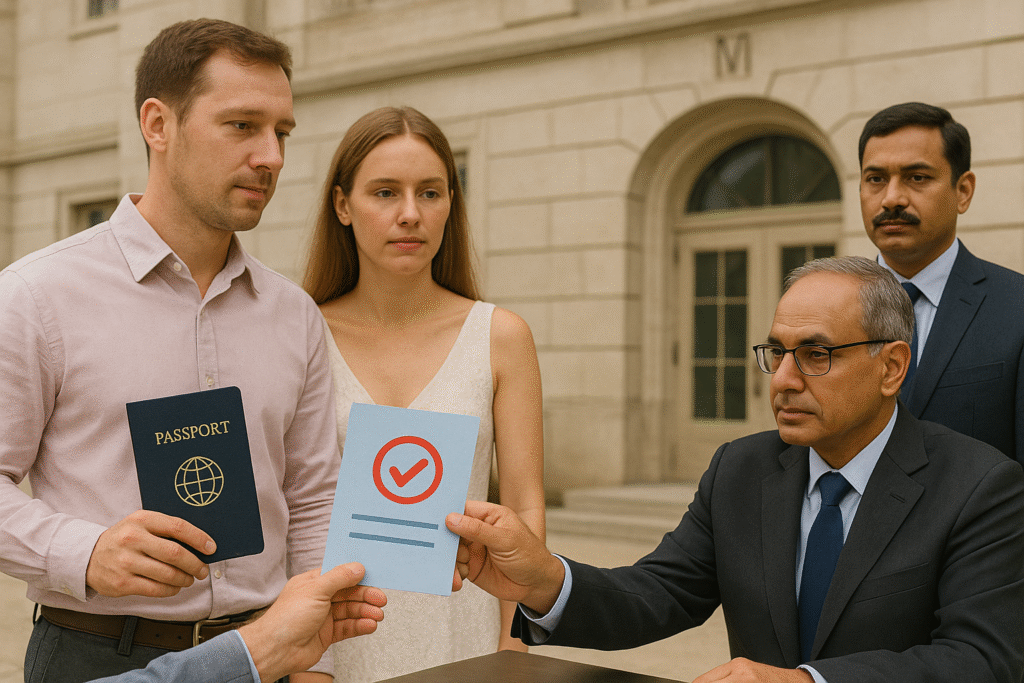
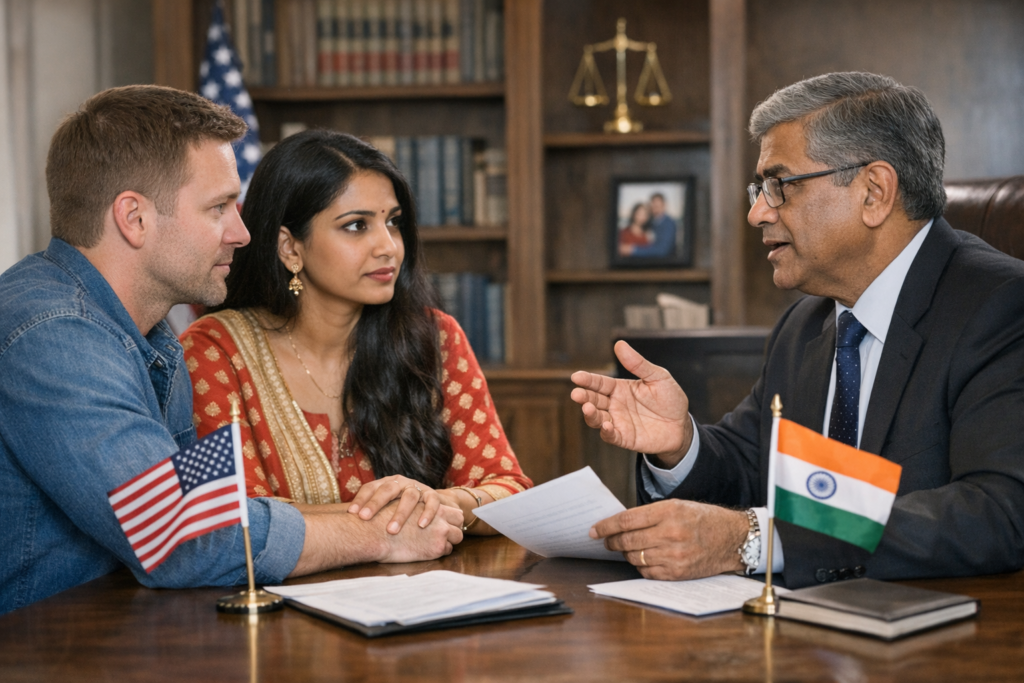
Marriage is universally recognized as a bond of companionship, shared residence, and emotional unity. However, in an increasing number of cross-border marriages, couples remain legally married yet forcibly separated due to immigration laws, domicile requirements, visa refusals, procedural or administrative delays, and heightened bureaucratic scrutiny. Many couples find themselves bound by law but divided by geography for years, enduring emotional distress, financial hardship, and prolonged legal uncertainty.
This painful reality is particularly evident in India–USA marriages, where one spouse resides in India while the other lives in the United States, sometimes for several years after marriage. This article examines the legal, immigration, and human dimensions of married couples living apart, with a special focus on India–USA cross-border marriages, remedies available under law, and practical guidance for affected spouses.
Understanding the Legal Reality of Married but Separated Couples
A marriage may be legally valid and socially recognized, yet still fail to confer an immediate right to cohabitation. This is because immigration law operates independently of family law.
- Family law governs the existence and validity of marriage.
- Immigration law governs entry, stay, residence, work authorization, and citizenship.
Marriage establishes a relationship—but does not automatically grant a visa, residency, or citizenship.
Common Legal Reasons for Post-Marriage Separation
Married couples are often forced to live apart due to the following legal reasons:
- Spouse visa refusal or petition denial
- Pending or excessively delayed immigration petitions
- Lack of permanent residence or domicile of the sponsoring spouse
- Insufficient financial sponsorship or income
- Allegations of non-genuine (sham) marriage
- Administrative processing, background checks, or security clearances
Immigration Law in India–USA Marriages
In India–USA marriages, immigration matters are governed primarily by United States Citizenship and Immigration Services and the U.S. Department of State.
Even where a marriage is perfectly valid under Indian or U.S. law, it may still fail to confer:
- Entry rights
- Residency rights
- Work authorization
- Citizenship eligibility
Immigration authorities evaluate documents, intent, domicile, compliance, and credibility—not emotions.
U.S. Spouse Visa Categories Affecting Married Couples
The most relevant visa pathways for married couples include:
- CR-1 / IR-1 Immigrant Spouse Visa
- K-3 Non-Immigrant Spouse Visa
- Adjustment of Status (if the spouse is already in the U.S.)
A rejected I-130 Petition for Alien Relative is often the single largest cause of prolonged marital separation.
Why Spouse Visa Petitions Are Commonly Rejected
1. Allegation of Non-Genuine (Sham) Marriage
Authorities assess whether the marriage was entered into solely for immigration benefit.
2. Insufficient Evidence
Common deficiencies include:
- Lack of joint documents
- Weak communication proof
- No financial interdependence
- Inconsistent timelines
3. Domicile & Sponsorship Issues
- U.S. spouse not domiciled in the United States
- Failure to meet income thresholds
- Absence of a joint sponsor
4. Procedural & Drafting Errors
Even genuine marriages fail due to poorly drafted petitions and legal inconsistencies.
Human, Emotional & Social Impact of Forced Separation
Living apart after marriage has consequences far beyond paperwork:
- Psychological stress, anxiety, and depression
- Social stigma, especially in traditional Indian societies
- Financial strain due to dual households
- Career interruption for the relocating spouse
- Long-term strain on marital stability
Courts and international bodies have acknowledged that state-imposed marital separation engages fundamental human rights, particularly the right to family life.
International Law on the Right to Family Life
Relevant International Instruments
- Article 16 – Universal Declaration of Human Rights
- Article 8 – European Convention on Human Rights (ECHR)
Landmark Case
Abdulaziz, Cabales and Balkandali v. United Kingdom
The European Court of Human Rights held that while states control immigration, arbitrary or disproportionate denial leading to prolonged spousal separation may violate the right to family life.This case is frequently cited worldwide to balance immigration sovereignty and marital unity.
U.S. Immigration Law & Judicial Approach
In the United States, spousal immigration is governed by federal statutes administered by USCIS under the Department of State.
Judicial Position in the U.S.
U.S. courts have consistently held that:
- Marriage does not create an absolute right to live together in the U.S.
- Visa denial does not automatically violate constitutional rights
Case Law
Kerry v. Din
The U.S. Supreme Court ruled that denial of a spouse’s visa does not necessarily violate the due-process rights of the U.S. citizen spouse.
However, dissenting opinions emphasized the constitutional importance of marriage and family unity, influencing later administrative discretion.
Legal Remedies Available to Separated Married Couples
1. Re-Filing Immigration Petitions with Stronger Evidence
Many rejected petitions can be cured by addressing:
- Documentation gaps
- Weak proof of marital intent
- Inconsistencies and drafting errors
2. Motions and Appeals
Available remedies include:
- Motion to Reopen
- Motion to Reconsider
- Administrative Appeals Office (AAO) appeal
Each remedy requires strict adherence to timelines and legal standards.
3. Fresh Petition with Legal Strategy
In many cases, filing a fresh I-130 petition with robust legal structuring is more effective than prolonged appeals.
4. Indian Legal Recognition & Documentation
Ensuring:
- Proper marriage registration
- Apostilled marriage certificates
- Affidavits confirming marriage validity
- Consistency across Indian and U.S. records
Establishing a Bona Fide (Genuine) Marriage Despite Separation
Immigration authorities apply the bona fide marriage test, focusing on intent, not physical proximity.
Courts recognize that:
Genuine marriages can exist despite prolonged separation, where separation is legally or practically unavoidable.
Evidence evaluated includes:
- Intent to share a life together
- Emotional commitment
- Financial interdependence
- Continuous communication
- Cultural and familial integration
Financial Sponsorship and Domicile Requirements
A U.S. citizen spouse must generally demonstrate:
- U.S. domicile or intent to re-establish domicile
- Sufficient income or a qualified joint sponsor
Failure to meet these requirements often leads to denial even when the marriage is genuine.
Frequently Asked Questions (FAQs)
❓ Can a rejected spouse visa case be cured?
Yes. Many cases are successfully cured through re-filing or corrective petitions.
❓ Is marriage registration in India mandatory?
While not mandatory everywhere, it is strongly advisable for immigration purposes.
❓ Does age difference affect visa approval?
No, by itself. However, it invites higher scrutiny requiring stronger proof.
❓ Is there a fundamental right to live together after marriage?
Morally yes; legally qualified and subject to immigration law.
❓ Does long separation weaken a marriage case?
No, if separation is involuntary and properly documented.
Conclusion
Being married yet living apart is not a failure of marriage, but a consequence of rigid legal frameworks struggling to reconcile state sovereignty with human reality.
Immigration law is strict—but not insurmountable. With the right legal strategy, documentation, and perseverance, marital unity can be restored.
At The Barrister Talk, we believe:
When immigration law keeps spouses separated, law must find a way.
If you are legally married but forced to live in different countries due to visa rejection, immigration delay, or domicile issues, you are not alone—and your case may still be legally curable. Marriage deserves unity. Immigration law must not permanently divide families.
If you need guidance or have questions, feel free to ask or consult our qualified legal professionals or reach out for reliable assistance or personalized support.
Subscribe to stay updated with the latest legal developments, immigration rules, and practical guidance for foreign nationals.