Before the introduction of the Four Labour Codes, India had 29 different labour laws governing employment and workplace regulations. Over time, these laws became outdated, complex, and fragmented. Companies were required to comply with numerous regulatory obligations, including multiple registrations, forms, licences, returns, and maintenance of various registers. At the same time, workers often did not receive clear and uniform protection under these scattered laws.
In 1991, India initiated major economic reforms and liberalisation, opening its economy to global competition. As businesses began expanding and integrating with global markets, the existing labour laws proved too rigid. Employers found it difficult to hire or restructure their workforce, modify working conditions, or manage compliance due to excessive paperwork and overlapping regulations.
Employers frequently complained that too many rules restricted business growth, while workers argued that existing laws failed to adequately protect employees in small establishments, informal sectors, and emerging forms of employment such as gig work and platform-based jobs.
With rapid globalisation, technological advancement, and changing employment patterns, the need for a simpler, flexible, and unified labour law system became evident.
Recognising these challenges, the Government of India acknowledged that the existing labour law framework was no longer suitable for the needs of a modern economy. To address this issue, the government constituted a commission of experts to review labour laws and recommend reforms.
This commission was known as the Second National Commission on Labour (2002), commonly referred to as SNCL or NCL 2002.
Second National Commission on Labour (2002)
The commission was officially set up on 15th October, 1999. It comprised of eight expert members representing government bodies, workers’ trade unions, company owners/employers, and academic institutions. The commissions was chaired by chairman, Shri Ravidra Verma, former Governor of Punjab and Kerala.
The expert members travelled and conducted extensive consultations across India, met thousands of workers, company owners/employers, trade unions, and state government representatives to understand the practical challenges within labour law framework. The government of India tasked the commission with following objectives:
- To review and simplify existing labour laws applicable to organised sector industries.
- To recommend a comprehensive umbrella framework providing basic protection to workers in the unorganised sector, including small shop employees, daily wage labourers, and informal workers.
While examining labour legislation, the commission also analysed how Indian labour laws should adapt to globalisation, modern technologies, and new forms of employment. The report emphasised the importance of balancing business competitiveness with workers’ rights, including wages, workplace safety, social security, and protection for women and children.
After extensive study, the commission concluded that the existing 29 labour laws were overlapping, outdated, and inefficient. It therefore recommended consolidating them into four comprehensive labour codes, organised according to functional areas.
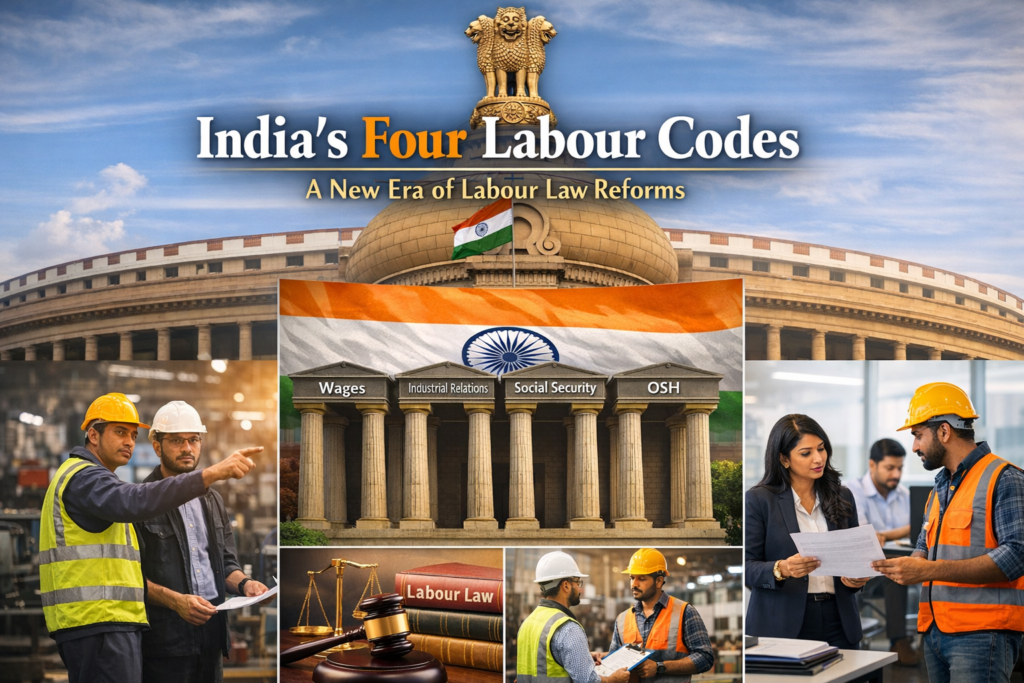
Introduction of the Four Labour Codes
Acting upon the recommendations of the commission, the Government of India enacted four consolidated labour codes between 2019 and 2020, replacing the earlier fragmented legal framework.
The Four Labour Codes are:
- Code on Wages, 2019
- Industrial Relations Code, 2020
- Code on Social Security, 2020
- Occupational Safety, Health and Working Conditions (OSH) Code, 2020
These four codes consolidated and replaced 29 earlier labour laws into a simplified regulatory structure.
Key Compliance Simplifications
The new labour codes introduce several compliance reforms, including:
- Single electronic return for labour law filings
- Eight unified registers instead of numerous separate registers
- Single registration and licensing mechanisms in many cases
- Recognition and social security provisions for gig and platform workers for the first time
The Government of India made them effective nationwide from 21 November 2025. Central draft rules were published on 30 December 2025 (objections invited), with final rules expected by April 2026.
During this transition period, existing rules continue to apply where they do not conflict with the new codes.
Applicability and Coverage of labour codes
The labour codes apply to most establishments, including factories, shops, offices, contractors, and digital platforms.
The definition of “worker” has been broadened to include most employees, excluding apprentices and certain high-level managerial personnel. In several codes, the supervisory salary threshold has been increased to ₹18,000 per month.
Non-compliance with the new labour codes may lead to substantial penalties, imprisonment, back wages, and labour disputes.
Objectives of the SNCL or NCL 2002
The Second National Commission on Labour recommended several reforms aimed at improving both business efficiency and worker protection.
These included:
- Creating flexible employment frameworks to support business growth
- Expanding social security coverage for unorganised and gig workers
- Linking minimum wages to cost of living
- Improving workplace safety standards
- Providing special protection for women and children
- Reducing excessive paperwork and compliance burdens
- Introducing modern employment concepts such as fixed-term employment
Businesses compliance checklist under the codes in 2026
To ensure compliance with the new labour codes, businesses should:
- Update payroll systems, employment contracts, and HR policies.
- Engage a Company Secretary or labour law compliance expert.
- Use the Shram Suvidha Portal for unified electronic filings.
- Conduct internal compliance audits at least quarterly.
- Train management teams and display statutory notices at workplaces.
Closing Insights
The Four Labour Codes represent a major reform in India’s labour law framework. They aim to simplify compliance for businesses through digital systems and unified regulations while strengthening worker protection, safety standards, and social security coverage.
These reforms create a balanced system that supports both economic growth and employee welfare, including protection for emerging categories of workers such as gig and platform workers.
Important Note: As the detailed rules are still being finalised, businesses should regularly check updates from the official Ministry of Labour and Employment (India) website (www.labour.gov.in) or consult a qualified labour law professional for guidance specific to their industry and state.
At The Barrister Talk,
Information and facilitation services are provided by seasoned legal professionals with proven expertise across complex legal and regulatory matters. We offer more than advice—we provide clear strategy, sound judgment, and dependable representation tailored to each client’s objectives.
Every engagement is approached with precision, confidentiality, and professional integrity. Whether advising individuals, founders, or enterprises, we combine rigorous legal analysis with practical insight, ensuring outcomes that are both legally sound and commercially sensible.
With The Barrister Talk, you gain access to trusted legal minds committed to protecting your interests and guiding you with confidence.