- A marriage between a Bangladeshi national and an Indian citizen in India is legally valid only when it is performed and registered strictly in accordance with Indian law. Any marriage that is not properly registered under the applicable Indian statute may face serious legal, immigration, and international recognition issues in the future.
1. Two Legal Routes to Marry in India
There are two legally recognised ways in which a Bangladeshi national and an Indian citizen can marry in India. Choosing the correct legal route is essential to ensure the marriage is valid, registered, and accepted for immigration and official purposes.
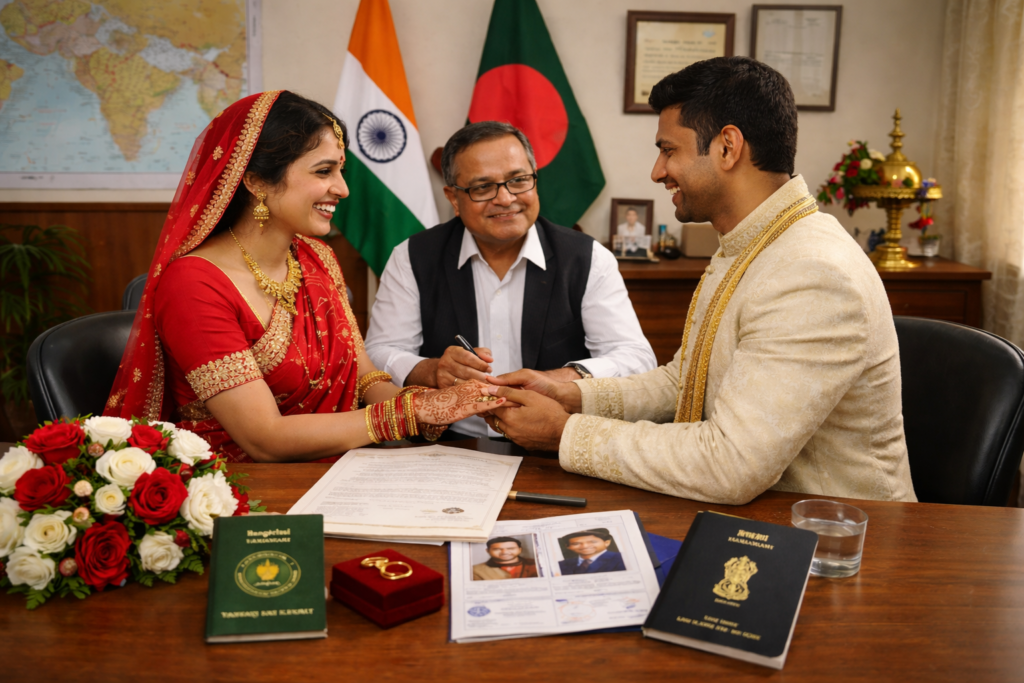
The most secure, legally sound, and internationally accepted method for such a cross-border marriage is registration under the Special Marriage Act, 1954.
The Special Marriage Act is a civil marriage law that:
- Is completely religion-neutral
- Applies to foreign nationals, including Bangladeshi citizens
- Does not require religious conversion even the couple belongs to different religions
- Provides a government-issued marriage certificate
A marriage certificate issued under the Special Marriage Act is widely accepted by:
- Indian authorities
- Foreign embassies and consulates
- Immigration and visa offices (including FRRO)
- Courts and government departments in India and abroad
Key Features:
- The marriage is registered directly with the Marriage Officer (SDM)
- A mandatory public notice is issued
- A 30-day waiting/objection period is required by law
- After completion of the notice period, the marriage is solemnised and registered
- A government-issued marriage certificate is provided
For this reason, the Special Marriage Act is considered the safest and most reliable legal route for a Bangladeshi national and an Indian citizen who wish to marry in India and avoid future legal or immigration complications.
This is the most commonly used and safest route for marriages involving a foreign national and an Indian citizen, as the certificate is nationally and internationally recognised.
Marriage Through Religious Ceremony with Mandatory Civil Registration
Marriage may also be solemnised according to the personal or religious laws of the parties, such as:
- Hindu marriage under the Hindu Marriage Act
- Muslim marriage (Nikah)
- Christian marriage under the Indian Christian Marriage Act
In this route, the marriage is first solemnised through a religious ceremony, such as at a temple, mosque, or church, in accordance with the personal law of the parties. After the ceremony, the marriage must be formally registered with the local Marriage Registrar under the applicable state registration rules. Without this civil registration, the marriage may face legal and immigration-related difficulties, especially where one spouse is a foreign national.
Important Note for Foreign Nationals or Bangladeshi
When one spouse is a foreign national, Marriage Registrars generally require:
- A Single-Status / No-Impediment Affidavit / No Objection Certificate
- Embassy or Consular attestation from the foreigner’s embassy or consulate
- Additional identity and visa verification documents
While both routes are legally valid, civil marriage under the Special Marriage Act is strongly recommended for cross-border marriages due to its clarity, neutrality, and wider acceptance by immigration authorities and foreign institutions.
2. Lawful Entry into India
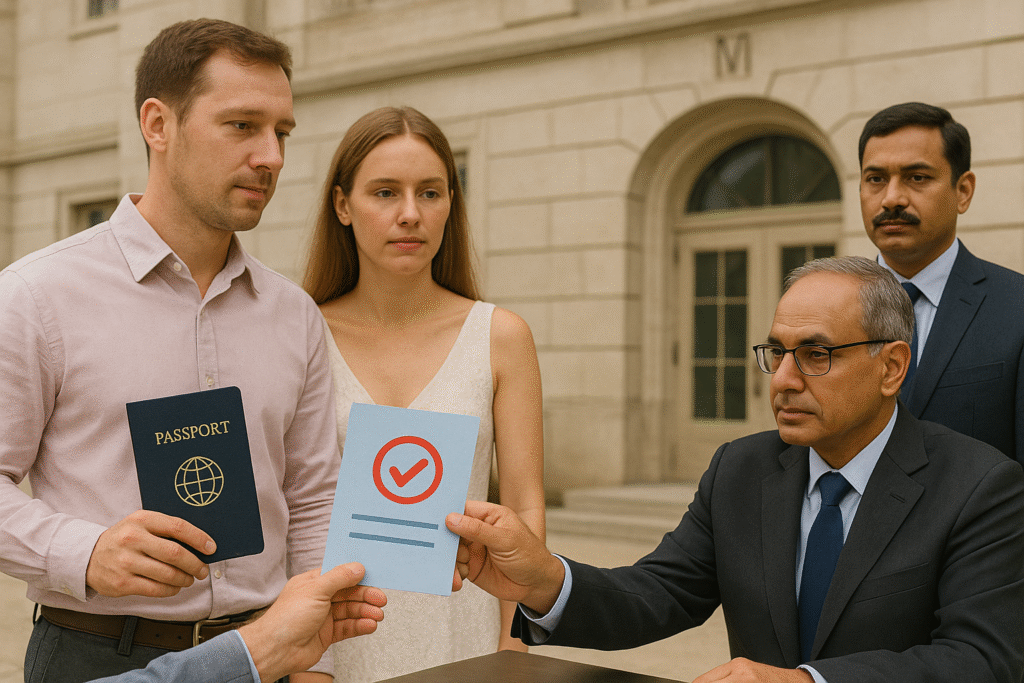
The Bangladeshi national must lawfully enter India before starting any marriage formalities. This requires:
- A valid Bangladeshi passport, and
- A valid Indian visa that remains valid for the entire duration of the marriage process, including the mandatory notice period.
It is extremely important that the visa does not expire during the marriage registration process.
Important Legal Warning: If the Bangladeshi national enters India illegally, overstays the visa, or violates visa conditions, the marriage can become legally vulnerable. Such violations may also lead to:
- Rejection of visa conversion or extension
- Problems with FRRO registration
- Future immigration or travel restrictions
Lawful entry and valid visa status are the foundation of a legally valid cross-border marriage in India.
3. Mandatory Documents from the Bangladeshi National
Before starting the marriage registration process in India, the Bangladeshi national must prepare certain mandatory documents. These are the core legal requirements. Please note that local Marriage Registrars may ask for additional documents or specific attestations, depending on the state or district.
Essential Documents Required
- Valid Bangladeshi Passport and Indian Visa
The original passport and clear photocopies must be produced. The Indian visa must remain valid for the entire duration of the marriage process, including the notice period. Marriage Registrars will verify both documents carefully. - Proof of Single Marital Status (No Objection / No-Impediment Certificate NOC/NIC) – Mandatory Document
This is a crucial requirement and can be provided in either of the following ways:- A Single-Status issued by a competent authority in Bangladesh, or
- An NOC sworn and notarised declaring single marital status, duly countersigned or attested by the Bangladesh High Commission or Consulate in India.
After obtaining the document, it must be:
- Attested by the Bangladesh Embassy or Consulate in India, and
- If required by the Marriage Registrar, further apostilled or attested through the Indian Ministry of External Affairs (MEA) for use in India.
The Bangladesh High Commission officially provides attestation services for such documents, and many Indian Marriage Registrars insist on this embassy attestation before accepting the papers.
- Proof of Age
Either:- A Birth Certificate or 10th Academic Certificate that is apostilled or embassy-attested, or
- Passport details accepted as age proof by the Marriage Registrar.
- Passport-Size Photographs
Recent photographs as per the specifications prescribed by the Marriage Office. - If Previously Married
- A certified divorce decree, or
- A death certificate of the former spouse,
Both documents must be duly attested or apostilled.
- Proof of Address
Current residential address proof. Some Marriage Registrars require local Indian address proof for at least one of the parties. - Certified Translations
Any document that is not in English or Hindi must be accompanied by a certified translation, along with proper attestation. - Embassy / Consular Attestation
Many Marriage Registrars in India insist on attestation by the Bangladesh High Commission or Consulate, especially for the single-status affidavit and personal documents. Such attestation services are officially provided by Bangladeshi diplomatic missions in India.
Most delays and rejections occur due to missing documents or lack of proper embassy attestation. Preparing all documents in advance and ensuring correct authentication significantly reduces legal and procedural complications.
4. X-2 Entry Visa: Special Rule for Bangladeshi Spouses
Bangladeshi nationals enjoy a specific and separate visa category under Indian immigration rules.
As per the rules issued by the Ministry of Home Affairs (MHA):
- Bangladeshi nationals who are legally married to Indian citizens are eligible for an X-2 (Entry) Visa
- This visa category is exclusive to Bangladesh nationals and is different from OCI
- OCI is not available to Bangladeshi or Pakistani nationals
- An X-2 visa can be issued for up to five years, subject to conditions
Once the marriage is legally completed and the official marriage certificate is issued by the Indian Marriage Registrar, the Bangladeshi spouse may either apply for an X-2 (Entry) Visa or apply for conversion of an existing valid visa into an X-2 visa through the FRRO, subject to approval by the competent immigration authorities and compliance with prescribed conditions.
5. Legal Risks and Compliances to Avoid in Bangladeshi–Indian Marriages
While Indian law allows a Bangladeshi national and an Indian citizen to marry, certain practical risks and legal pitfalls must be carefully managed. Ignoring these issues can lead to delays, rejection of registration, or serious immigration consequences.
Public Notice Risk under the Special Marriage Act
The Special Marriage Act, 1954 requires the Marriage Officer to publish a public notice for 30 days before the marriage is solemnised.
This public notice may:
- Invite objections from third parties
- Expose the couple to social pressure or unwanted publicity
- Create safety or privacy concerns in sensitive cases
If there is any concern regarding personal safety, family opposition, or harassment, the marriage process should be planned with caution and care. It is strongly advisable to seek professional legal assistance at an early stage and, where required, to take appropriate legal or protective remedies to safeguard the rights, privacy, and security of both parties during the marriage process.
Strict Compliance with Visa Conditions
Foreign nationals must strictly follow Indian visa rules.
- Entering India on a tourist visa does not permit long-term stay or employment after marriage
- Staying or working in India without visa conversion is illegal
- Visa overstay or misuse can result in:
- FRRO rejection
- Fines or detention
- Future visa bans or deportation proceedings
For any extended stay after marriage, the Bangladeshi spouse must apply for visa conversion or registration through the FRRO within the prescribed time.
Authenticity and Attestation of Foreign Documents
Indian Marriage Registrars require foreign documents to be genuine and properly authenticated.
- Documents must be attested or apostilled, as applicable
- Many registrars insist on countersignature or attestation by the Bangladesh Embassy or Consulate
- Unattested or improperly verified documents are a common reason for rejection or delay
Early planning of attestation and authentication is strongly recommended to avoid last-minute legal complications.
Most problems in cross-border marriages arise not from the law itself, but from procedural lapses and documentation errors. Careful compliance with notice requirements, visa rules, and attestation procedures ensures a smooth and legally secure marriage process.
Why The Barrister Talk Recommends SMA a Legal Route for Bangladeshi Indian Marriages
The Barrister Talk strongly recommends this route of marriage under the Special Marriage Act, 1954 because it provides maximum legal safety, long-term security, and international acceptance for cross-border couples.
This approach is recommended because it it offers maximum legal protection and possibly avoid every legal hurdles unlike to personal marriage laws that may occurs in future:
Is recognised across India and internationally
The marriage certificate issued under Indian law is valid and accepted by government authorities in India and abroad.
Is accepted by FRRO, immigration authorities, and embassies
This route is routinely relied upon for visa conversion, residence permissions, and immigration filings.
Prevents future legal disputes about the validity of marriage
Proper registration under Indian law avoids challenges related to proof of marriage, documentation gaps, or jurisdictional objections.
Avoids complications arising from religious conversion or informal ceremonies
It removes the need for conversion and reduces the risk of rejection caused by unregistered or purely religious marriages.
Cross-border marriages often face problems years later, not at the time of marriage. Choosing the correct legal route from the beginning ensures peace of mind, legal certainty, and smooth immigration compliance in the future.
If you need guidance or have questions, feel free to ask or consult our qualified legal professionals or reach out for reliable assistance or personalized support.
Subscribe to stay updated with the latest legal developments, immigration rules, and practical guidance for foreign nationals.