
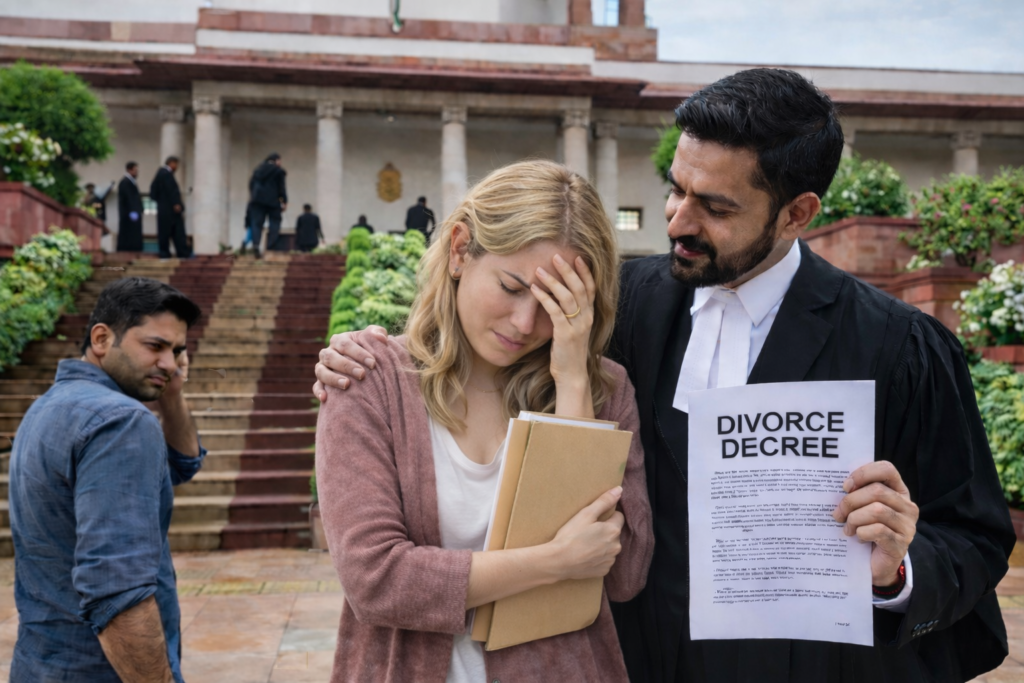
In an increasingly globalized and modern world, cross-border marriages between foreign nationals and Indian citizens are common. Such marriage are often solemnized in India under various personal laws or civil statutes, including the Hindu Marriage Act, 1955 (HMA), Special Marriage Act, 1954 (SMA), Foreign Marriage Act, 1969 (FMA) depending on the religious or civil nature of ceremony.
Marriage is traditionally regarded as sacred union in India. However, in the context of cross-border marriage, couples typically entered into matrimony based on mutual love, consent, and affection, unlike tradition/arrange marriage comes with strict practices prevalent in Indian society.
However, when such marriages break down due to irreconcilable differences, infidelity, jurisdictional conflicts, or other unavoidable grounds, navigating the divorce process in cross-border marriages can be particularly complex. These complexities arise from conflicting jurisdictions, divergent legal frameworks, and enforcement challenges across countries.
For a foreign spouse (non-Indian citizen) seeking a divorce from an Indian spouse, legal remedies may be pursued either in India or abroad. However, the validity and enforceability of a divorce decree, especially one obtained from a foreign court, are heavily dependent on strict compliance with Indian law.
Note: Indian courts do not automatically recognize foreign decrees, and failure to meet the legal requirements can leave the marriage legally subsisting in India, potentially leading to issues like bigamy risks, property disputes, or unresolved child custody matters.
Indian Legal Framework Governing Cross-Border Divorces
Indian matrimonial laws are largely personal and religion-specific, though secular or civil legal options are flexible and available for interfaith and international marriages. In cases involving foreign spouses married to Indian citizens, the applicable legal framework depends on the nature of the marriage, the law under which it was solemnized, the place of solemnization, and the religion of the parties, whether the marriage took place in India or abroad.
Applicable Laws for Cross-Border Marriages:
- Special Marriage Act, 1954 (SMA): This secular law applies to civil marriages, including those between a foreign national and an Indian citizen, irrespective of their religion. It enables religion-neutral registration and provides grounds for divorce such as adultery, cruelty (physical or mental), desertion for at least two years, mental disorder, incurable venereal disease, or mutual consent (following one year of separation). The SMA is frequently used for cross-border marriages in India due to its neutral and inclusive nature.
- Foreign Marriage Act, 1969 (FMA): The Foreign Marriage Act, 1969 governs marriages between an Indian citizen and a foreign national solemnized outside India before a Marriage Officer. If the marriage was solemnized within India, the applicable law would typically be the SMA or relevant personal law. Divorce provisions under the FMA substantially mirror those under the SMA.
- Hindu Marriage Act, 1955 (HMA): The Hindu Marriage Act, 1955 applies when the marriage is solemnized under Hindu rites and ceremonies, and both parties are Hindus (or where one spouse has legally converted to Hinduism). A foreign spouse may fall within the scope of the HMA if:
- They have converted to Hinduism, or
- The marriage is otherwise legally recognized as a Hindu marriage.
The grounds for divorce under the HMA are broadly similar to those under the SMA, including cruelty, adultery, desertion, mental disorder, and mutual consent.
- Other personal laws Depending on the religion of the parties at the time of marriage:
- Indian Divorce Act, 1869 (for Christians) — Governs solemnization and dissolution.
- Parsi Marriage and Divorce Act, 1936 — Specific to Parsi Zoroastrians.
- Muslim Personal Law (Shariat Application Act, 1937, and Dissolution of Muslim Marriages Act, 1939) — Applies to Muslim marriages, allowing talaq, khula, or judicial dissolution on grounds like cruelty or desertion. These laws take precedence for marriages solemnized under their respective rites.
Grounds for Divorce in Cross-Border Marriages in India
Indian matrimonial laws provide structured grounds for divorce, primarily fault-based, with a separate provision for mutual consent. These grounds apply depending on the applicable statute (e.g., Hindu Marriage Act, 1955, Special Marriage Act, 1954, or Foreign Marriage Act, 1969), which often mirror each other for secular or international unions. Courts interpret these grounds broadly, especially cruelty, to address modern realities like emotional abuse or abandonment in cross-border divorces.
1. Mutual Consent Divorce
Both parties agree to end the marriage after living separately for at least one year and mutually consenting to dissolution.
- Under HMA: Section 13B requires a joint petition, a mandatory six-month cooling-off period (waivable in exceptional cases as per Supreme Court rulings), and final confirmation.
- Under SMA/FMA: Similar provisions apply (Section 28), making this the fastest and least contentious route for foreign spouses or international couples.
This option is ideal when both spouses cooperate, avoiding prolonged litigation common in NRI or cross-border matrimonial disputes.
2. Contested (Fault-Based) Divorce
Either spouse can petition on proven fault grounds. Key common grounds across HMA (Section 13(1)), SMA (Section 27), and FMA (which incorporates SMA provisions) include:
- Adultery: Voluntary sexual intercourse by one spouse with a person other than their partner after marriage solemnization. Proof can be direct or circumstantial; it remains a strong ground in fault-based systems.
- Cruelty (Physical or Mental): The most frequently invoked and expansively interpreted ground. It covers physical violence, mental harassment, emotional abuse, false allegations, dowry demands, denial of conjugal rights, or behavior making cohabitation unreasonable. The Hon’ble Supreme Court of India, in many cases, emphasized that mental cruelty is established if there is prolonged separations or abusive conduct by either party.
- Desertion: Willful abandonment without reasonable cause or consent for a continuous period of at least two years immediately before filing. Includes willful neglect; courts require proof of intent to permanently end cohabitation.
- Conversion to Another Religion: If one spouse ceases to be Hindu (under HMA) or renounces their faith and converted into another religion that disrupts the marriage.
- Unsound Mind / Mental Disorder: Incurable unsoundness of mind or continuous/intermittent mental disorder (e.g., schizophrenia, psychopathic disorder) rendering cohabitation unreasonable. Medical evidence is essential.
- Venereal Disease: Communicable form in a serious state (now less common due to medical advances but still statutory).
- Renunciation of the World: Entering a religious order (under HMA).
- Presumption of Death: Not heard alive for seven years or more.
Additional grounds under SMA (often relevant for interfaith/cross-border marriages):
- Imprisonment for seven years or more under IPC.
- For wives: Husband’s rape, sodomy, or bestiality; or non-resumption of cohabitation after a maintenance decree.
These grounds ensure fault is established, aligning with India’s traditional emphasis on preserving marriage unless serious misconduct occurs.
3. Irretrievable Breakdown of Marriage
This is not a statutory ground under HMA, SMA, or FMA. However, the Supreme Court has exercised extraordinary powers under Article 142 of the Constitution (to do complete justice) to dissolve marriages in exceptional cases where:
- The marriage is emotionally dead and beyond repair.
- Parties have lived separately for extended periods (e.g., years or decades).
- Continuation causes mental agony, clogs courts, or serves no purpose.
Landmark Cases:
- Shilpa Sailesh v. Varun Sreenivasan (2023): Constitution Bench affirmed Article 142 power for irretrievable breakdown, even without mutual consent.
- Neha Lal v. Abhishek Kumar (January 2026): Dissolved marriage after short cohabitation and prolonged litigation/abuse.
Courts dissolved “dead marriages” to prevent abusive litigation, emphasizing mediation but granting relief where separation exceeds 10+ years or involves repeated disputes.
Jurisdiction for Foreign Spouses Filing Divorce in India
Foreign spouses who seek to dissolve a cross-border marriage in India must establish proper jurisdiction to ensure that the proceedings remain valid and enforceable. Indian family courts derive their authority from specific statutory provisions and prioritize clear connections to India, such as the place of marriage or the residence of the parties. This legal framework protects both spouses while accommodating international elements and permits foreign spouses to initiate proceedings even while residing abroad.
Under Section 19 of the Hindu Marriage Act, 1955 or equivalent provisions in other matrimonial laws such as Section 31 of the Special Marriage Act, 1954 and Section 18 of the Foreign Marriage Act, 1969, foreign spouse can file a divorce petition in an Indian family court if any of the following conditions are met:
- Marriage Solemnized in India: The Divorce petition can be filed in the district court (or family court) where the marriage took place. This is a strong jurisdictional hook for unions performed in India, regardless of the couple’s current locations.
- Indian Spouse (Respondent) Resides in India: Jurisdiction lies in the court of the district where the Indian partner currently lives, making it accessible even if the foreign spouse is overseas.
- Couple Last Resided Together in India: If the parties cohabited in India at any point (e.g., post-marriage honeymoon or early years), the court in that district has jurisdictional power to entertain the case. This provision captures the “matrimonial home” concept.
- Special Provision for the Wife (Petitioner): Under Section 19(2) HMA or Section 31(2) SMA, if the foreign spouse is the wife, she can file in the court where she resides—whether in India or abroad (with the case transferred or handled accordingly). This gender-specific rule offers added protection in cases of abandonment or domestic issues, and it applies to foreign wives as well.
These rules extend to other personal laws (e.g., Section 10 of the Indian Divorce Act, 1869 for Christians), ensuring consistency across statutes. Importantly, Indian courts retain jurisdiction over marriages solemnized in India, even if one or both parties are non-residents, to prevent forum shopping abroad that evades Indian personal laws.
Filing from Abroad: Using Power of Attorney (PoA)
Even if the foreign spouse lives overseas, physical presence is not mandatory. The mandatory legal proceedings can be initiated and conducted remotely, streamlining NRI or international divorce processes. The key mechanism is a Power of Attorney (PoA), which allows the foreign spouse to authorize an Indian representative (e.g., a lawyer, relative, or agent) to file, appear, and argue on their behalf.
Note: Post-COVID reforms (extended into 2026) also permit video conferencing for evidence, cross-examinations, and final arguments under Order XVIII Rule 4A of the CPC, reducing travel burdens. This is particularly useful for foreign spouses in time zones away from India.
Recent Judicial Trends and Challenges
Supreme Court and High Court rulings (e.g., Anuradha Bhasin v. Union of India extensions in 2025) emphasize virtual hearings for cross-border divorce jurisdiction, but challenges persist:
- Forum Non Conveniens: Courts may decline if India is not the “natural forum” (e.g., both parties abroad with no Indian assets), per Modi Entertainment Network v. WSG Cricket Pte. Ltd. (2003).
- Transfer Petitions: Under Section 25 CPC, parties can seek transfer to a more convenient court (e.g., from Tamil Nadu to Karnataka for Bengaluru residents or Bengaluru to Delhi Residents).
- Enforceability: Indian divorce decrees are globally apostilled for recognition abroad, but foreign filings require Section 13 CPC compliance.
Note: The choice of law and jurisdiction significantly impacts enforceability, recognition of foreign decrees, maintenance, child custody, and property division.
Court Priorities and Timelines
Indian courts prioritize parties’ welfare (especially children, vulnerable spouses) and encourage mediation/reconciliation in international contexts. However, judicial backlogs often extend:
- Mutual consent: 6–18 months (faster with waivers).
- Contested cases: 2–5+ years (or longer in appeals), though recent reforms promote faster resolutions via video hearings and priority for NRI/foreign matters.
For foreign spouses, proving grounds (e.g., desertion/abandonment) with evidence like communications or witnesses is key. Mutual consent remains preferable for speed and reduced conflict.
Why Cross-Border Divorces Are Legally Challenging
Cross-border divorce cases involving Indian citizens and foreign nationals present unique legal complexities, including:
- Multiplicity of personal laws in India, governed by religion or civil registration statutes.
- Jurisdictional overlap between Indian Family Courts and foreign courts, often leading to parallel proceedings.
- Risk of non-recognition of foreign divorce decrees: Landmark Supreme Court rulings, beginning with Narasimha Rao v. Y. Venkata Lakshmi (1991) and reaffirmed and clarify that a foreign divorce decree is conclusive in India only if it satisfies the conditions under Section 13 of the Code of Civil Procedure, 1908. These include:
- Competent jurisdiction of the foreign court
- Decision on merits
- Grounds consistent with Indian matrimonial law
- Compliance with principles of natural justice
- No violation of Indian public policy
- Enforcement hurdles: Ex parte (one-sided) foreign divorce decrees are frequently rejected by Indian courts, whereas mutual consent divorces obtained abroad have a higher likelihood of recognition, provided both parties participated voluntarily and jurisdictional requirements are met.
Recent decisions from High Courts and the Supreme Court in India continue to apply strict judicial scrutiny, particularly where foreign divorce grounds such as “irreconcilable differences”—commonly accepted overseas—do not align with statutory grounds recognized under Indian law, such as cruelty, desertion, or adultery.
Final Legal Words
Cross-border divorces involving foreign nationals and Indian citizens require careful and strategic navigation of Indian matrimonial laws to ensure the validity and enforceability of divorce decrees. Initiating divorce proceedings in India generally offers greater legal certainty, whereas divorces obtained abroad must strictly comply with the conditions laid down under Section 13 of the Code of Civil Procedure, 1908, to be recognized and enforced in India.
For personalized guidance—especially in cases involving abandonment, NRI elements, or foreign proceedings—consult a well-qualified family lawyer experienced in international matrimonial law.
If you need guidance or have questions, feel free to ask or consult our qualified legal professionals or reach out for reliable assistance or personalized support.
Subscribe to stay updated with the latest legal developments, immigration rules, and practical guidance for foreign nationals.