
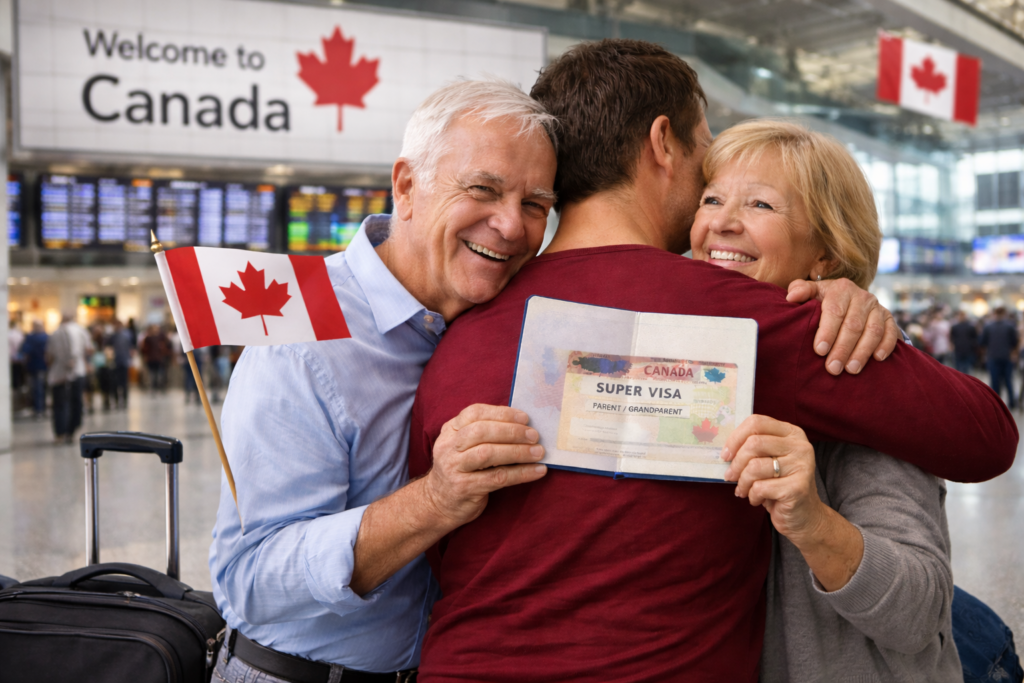
A Canada Super Visa is a special long-term visitor visa for the parents and grandparents of Canadian citizens or permanent residents. It allows them to visit Canada and stay for a much longer time than a normal visitor visa, while still remaining temporary visitors.
What Is Allowed Under the Canada Super Visa?
A parent or grandparent may stay in Canada for up to 5 years on each visit, subject to immigration approval at the time of entry. The visa is usually issued as a multiple-entry visa and can be valid for up to 10 years, allowing travel in and out of Canada during that period.
Restrictions and Limitations
The Super Visa is only a visitor visa. It does not allow work or study. It also does not provide any pathway to permanent residence. The holder of Super Visa must comply with all visitor conditions and leave Canada when the authorized stay ends.
Why Canada Offers the Super Visa – Purpose
The Super Visa is intended to help families spend longer time together in Canada without the need to repeatedly apply for short-term visitor visas. It is not an immigration or settlement visa, but a facility for extended family visits under Canadian immigration law.
Applicant Eligibility Requirements
A Canada Super Visa can be applied for by a person who is the parent or grandparent of a Canadian citizen or a Canadian Permanent Resident (PR) or Registered Indian. The applicant must be outside Canada at the time of submitting the application, as the Super Visa is issued as an entry visa.
Legal Requirements for the child or grandchild / Sponsor in Canada
The child or grandchild inviting the applicant must be a Canadian citizen or a permanent resident or Registered Indian and must meet the minimum income requirement, known as the Low Income Cut-Off (LICO), as prescribed under Canadian immigration rules. This income requirement ensures that the visitor/applicant will be financially supported during their stay in Canada.
Mandatory Requirements
Documents from the Child or Grandchild (Sponsor – Canadian citizen, Permanent Resident of Canada or Registered Indian)
The sponsor in Canada must be at least 18 years old and lives in Canada. The Sponsor must provide a copy of one of the the following documents:
- Canadian citizenship document of the host (and of their spouse or common-law partner, if applicable)
- Permanent Resident (PR) document of the host (and of their spouse or common-law partner, if applicable)
- Secure Certificate of Indian Status or Certificate of Indian Status (status card)
A Signed Invitation letter
An invitation letter must be issued by the child or grandchild residing in Canada. The letter should clearly state that the visitor will be financially supported during the stay, explain the exact family relationship between the sponsor and the applicant, and specify the intended duration and purpose of the visit in Canada. The language of the letter should be clear and formal, confirming that the visit is temporary in nature and made in compliance with Canadian immigration requirements.
Medical Health Insurance (Very Important)
The applicant is required to obtain private medical Health Insurance from a Canadian insurance company OR an insurance company outside Canada that is authorized by the Office of the Superintendent of Financial Institutions (OSFI) under the Insurance Companies Act to provide accident and sickness insurance.
Insurance purchased from non-Canadian insurers or travel agents outside Canada is not acceptable for Super Visa purposes.
Note: Insurance brokers and insurance claims administrators are not insurance companies and will not appear on the OSFI list.
There are certain mandatory conditions for Medical Health Insurance which include:
- The insurance policy must provide a minimum coverage of CAD 100,000. This coverage is intended to protect against the high cost of medical treatment in Canada and must be sufficient to cover emergency medical care, hospitalization, and repatriation (return to the home country in case of serious illness or death).
- The policy must be valid for at least one full year from the date of entry into Canada. Short-term or partial-year policies do not meet Super Visa requirements, even if the applicant intends to stay for a shorter period initially.
- Importantly, the insurance policy must be fully paid and active at the time the Super Visa application is submitted. Merely providing an insurance quote, proposal, or unpaid policy document is not accepted. Proof of payment and a valid policy certificate must be submitted with the application.
This medical insurance requirement is mandatory and is strictly reviewed by Canadian immigration authorities, as it directly affects public health costs and the applicant’s admissibility as a long-term visitor to Canada.
Immigration Medical Examination
The applicant is required to undergo a medical exam with an approved panel physician as part of the Super Visa process. This medical examination must be conducted only by a doctor approved by IRCC (Immigration, Refugees and Citizenship Canada), commonly referred to as a panel physician. Medical examinations carried out by non-approved doctors are not accepted.
The purpose of the examination is to assess whether the applicant meets Canada’s health admissibility standards. Once the examination is completed, the medical results are submitted directly by the panel doctor to IRCC through the official system. The applicant does not receive or submit the medical report themselves, except for the proof of completion, if provided.
Financial Proof /Income of the Sponsor
The child or grandchild living in Canada (the sponsor) must prove that they earn enough income to support the visiting parent or grandparent. This income must meet the Low Income Cut-Off (LICO) set by the Canadian government. The purpose of this requirement is to ensure that the visitor will be financially supported and will not depend on public funds in Canada.
Low Income Cut-Off (LICO)
| Size of Family Unit | Minimum necessary gross income |
|---|---|
| 1 person (your child or grandchild) | $30,526 |
| 2 persons | $38,002 |
| 3 persons | $46,720 |
| 4 persons | $56,724 |
| 5 persons | $64,336 |
| 6 persons | $72,560 |
| 7 persons | $80,784 |
| More than 7 persons, for each additional person, add | $8,224 |
Follow the link How to calculate family size
The most important document for proving income is the Notice of Assessment (NOA) issued by the Canada Revenue Agency (CRA) for the most recent tax year. This document officially confirms the sponsor’s declared annual income and is the primary proof relied upon by Canadian immigration authorities.
In addition to NOA, the sponsor may be further required to submit
- An employment letter or business documents confirming their job status, position,
- Recent pay slips or bank statements as applicable and/or
- Other income documents,
In addition to the Notice of Assessment (NOA), the additional financial documents required depend on the sponsor’s current employment or business situation. If the sponsor is salaried, documents such as an employment letter, recent pay slips, and bank statements may be submitted. If the sponsor is self-employed or running a business, business registration documents, income statements, and relevant financial records may be required. Other income-related documents may also be provided, as applicable, to clearly demonstrate the sponsor’s financial stability and continued ability to support the visiting parent or grandparent during their stay in Canada.
Proof of Relationship
The applicant must submit clear and reliable documents to establish the family relationship with the child or grandchild in Canada. The primarily documents required for this purpose include:
- A Copy of the Host/Sponsour’s Birth certificates or Baptismal Certificate that link the applicant to the sponsor, along with
- A family tree or relationship chart for clarity.
- Copies of the passports of both the applicant and the sponsor to confirm identity and consistency of personal details.
- Another official document naming you as the parent or grandparent of your host
These primary documents are essential to prove eligibility for the Canada Super Visa and are closely scrutinized by Canadian Immigration Authorities.
Documents Required (India-Specific)
Documents from the Applicant (India)
The applicant in India must submit a
- Valid passport (preferably with long validity),
- IMM 5257 Visitor Visa Application Form, and
- Family Information Form,
- Recent photograph meeting IRCC specifications.
- Documents showing strong ties to India such as property ownership papers or a rent agreement, pension documents or bank statements, and
- Details of close family members residing in India.
In addition, A Police Clearance Certificate (PCC) is recommended, though not mandatory. While not required in every case, providing a PCC can help strengthen the application by demonstrating good background and compliance history.
Medical Examination India – Specific
The medical examination must be completed only through doctors approved by IRCC (Immigration, Refugees and Citizenship Canada). Medical tests done by any other doctor or hospital are not accepted.
In India, these IRCC-approved panel doctors are available in major cities such as
Ahmedabad, Bangalore, Chandigarh, Chennai, Guwahati, Hyderabad, Kerala, Kolkata, Ludhiana, Mohali, Mumbai, New Delhi, Pune, and Trivandrum.
The approximate cost of the medical examination ranges between ₹6,000 and ₹9,000, depending on the city and clinic.
Once the examination is completed, the panel doctor sends the medical results directly to IRCC through the official system. The applicant does not submit the medical report themselves, except for proof of completion if required.
The immigration medical examination may be completed after receiving medical instructions from IRCC, or it may be done as an upfront medical, if the applicant chooses this option while submitting the Super Visa application.
Minimum Income Requirement (LICO Compliance)
The child or grandchild living in Canada (the sponsor) must meet the Minimum Income Requirement, also called the Low Income Cut-Off (LICO). This income threshold is set by the Canadian government to ensure that the parent or grandparent visiting Canada will be financially supported and will not rely on public assistance during their stay.
Family size is calculated by counting the sponsor, the sponsor’s spouse or partner, any dependent children, and the parent or grandparent applying for the Super Visa. Find the link:- How to calculate family size
Processing Time (India)
For applications filed from India, the average processing time for a Canada Super Visa is generally around 6 to 10 weeks.
However, this time period is indicative, not fixed or guaranteed and may extend further if additional steps are required, such as medical clearance, background verification, or security checks by Canadian immigration authorities.
Processing times may increase
The Immigratio Levels Plan sets the number of newcomers that Canada plans to welcome each year. If there are more people applying than available spaces, processing times may increase.
Note:- The Applicant may need to give biometrics with his/her application. This processing time doesn’t include the time the applicant need to give biometrics.
What is the IMM 5257 – Visitor / Super Visa Application Form?
The IMM 5257 is the official application form used to apply for a Temporary Resident Visa (Visitor Visa) to Canada. It is the primary form required by Immigration, Refugees and Citizenship Canada (IRCC) for individuals who wish to enter Canada as visitors, including those applying for a Canada Super Visa.
Purpose of the IMM 5257 form
The IMM 5257 form is used by Canadian immigration authorities to collect essential personal and background information about the applicant. This includes details such as identity and passport information, travel history, purpose of travel, family information, and background declarations related to security, health, and previous immigration history.
Why IMM 5257 is important
The information provided in IMM 5257 helps IRCC assess whether the applicant:
- Meets the requirements of a temporary visitor
- Has a genuine purpose of travel
- Poses no security or health risk
- Is likely to comply with visa conditions and return after the authorised stay
Use of IMM 5257 for Super Visa
For a Canada Super Visa, IMM 5257 is completed as a visitor visa application, with the purpose of travel clearly stated as a Super Visa for parents or grandparents. Accuracy and consistency in this form are critical, as errors or inconsistencies may lead to delays or refusal.
In summary, IMM 5257 is the core application form for visiting Canada, and it forms the foundation of the Super Visa application.
Other conditions IRCC consider
IRCC considers several other things before deciding or granting Super Visa if the Applicant can come to Canada. The Applicant must be a genuine visitor to Canada who will leave by choice at the end of his/her visit.
When you apply for Super Visa, IRCC shall also consider following other conditions:-
- Applicant ties to your home country
- The purpose of applicant’s visit
- Applicant family and finances
- the overall economic and political stability of your home country
Why Super Visa Applications Get Refused (Common Mistakes to Avoid)
- Canada Super Visa applications are often refused due to specific and avoidable risk factors. One common ground for refusal is documentation and presentation errors, where forms, supporting documents, or explanations are incomplete, inconsistent, or unclear.
- Applications may also be refused if the sponsor’s proof of income is weak or insufficient and does not clearly meet the Low Income Cut-Off (LICO) requirement prescribed by Canadian immigration authorities.
- Another major risk arises when the medical insurance does not strictly comply with Super Visa rules—such as when it is not issued by a Canadian insurance company, provides less than the required coverage, or is not fully paid at the time of application.
- Refusals also occur where there is an absence of clear evidence showing the applicant’s intention to return to India, including weak or missing proof of family, financial, or property ties.
- Lastly, an incomplete, unclear, or poorly drafted invitation letter can create doubts about the genuineness of the visit and whether the stay in Canada is truly temporary in nature, leading to refusal.
Important Advisory Note
A strong Canada Super Visa application must clearly demonstrate the applicant’s intention to return to India after the visit. This intention is best supported by providing evidence of close family members residing in India, property ownership or long-term residence, and financial stability, such as a pension or regular source of income.
The invitation letter should be professionally drafted and must clearly set out the financial support to be provided by the sponsor as well as confirm the temporary nature of the visit. Care should be taken to avoid tourist-style or casual language, as Super Visa applications are examined under stricter legal and compliance standards than ordinary visitor visa applications.
Why Immigration Lawyer / Expert Help is Strongly Recommended
In practice, a significant number of Super Visa refusals from India occur not because the applicant is ineligible, but because the application is poorly presented or legally weak. Professional assistance should be seriously considered where risk factors are present. These include cases where the applicant is aged 60 years or above, the sponsor’s income is close to the minimum LICO threshold, the applicant is retired or has no active employment, property or financial ties to India are weak or poorly documented, or there is a previous visa refusal from any country. These factors exist in a large number of parent-based Super Visa applications from India.
A Super Visa is not a simple tourist visa. Unlike short-term visitor visas, Canadian immigration authorities closely assess the risk of non-compliance, the genuineness of temporary intent despite a long permitted stay, the long-term healthcare impact, and the sponsor’s ability to maintain income over time. A lawyer or trained expert structures the application to carefully balance a long stay in Canada with clear temporary intent, remove inconsistencies across forms and letters, and proactively address concerns that an immigration officer is likely to raise.
Technical and legal presentation is often decisive. Even small mistakes—such as weak or casual invitation letter language, incorrect calculation of family size for LICO, medical insurance policies that do not strictly meet IRCC wording, or a poor explanation of the applicant’s obligation to return to India—can lead to refusal. A qualified immigration lawyer prepares a legal covering submission, aligns the facts with the Immigration and Refugee Protection Regulations (IRPR) and IRCC program delivery instructions, and ensures that the application does not create misrepresentation or credibility issues that could affect future Canadian visa applications.
Conclusion
A Canada Super Visa is a temporary visitor visa, and the visa holder is required to leave Canada before the authorised period of stay expires, unless an extension is lawfully approved. An application for extension may be made from within Canada, subject to the discretion and approval of Canadian immigration authorities. It is important to clearly understand that the Super Visa does not lead to permanent residence (PR) and should not be treated as an immigration or settlement pathway, but only as a facility for extended family visits under Canadian immigration law.
If you need guidance or have questions, feel free to ask or consult our qualified legal professionals or reach out for reliable assistance or personalized support.
Subscribe to stay updated with the latest legal developments, immigration rules, and practical guidance for foreign nationals.