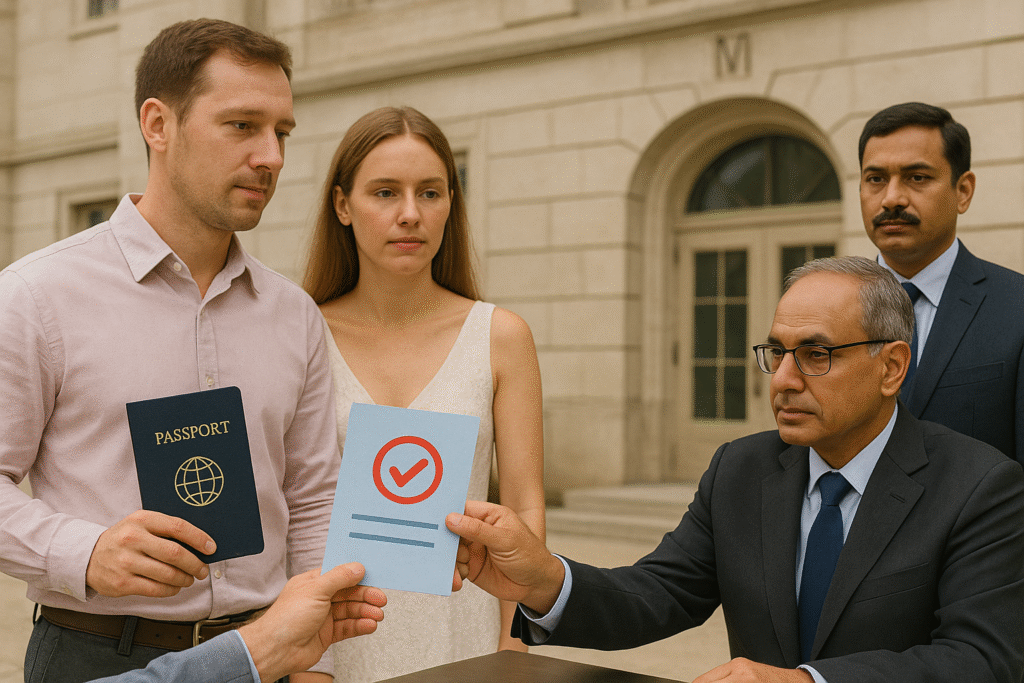

Before examining timelines, the religion of both parties must first be determined. Where both parties belong to the same religion, such as Hindu, Muslim, or Christian, the marriage may be solemnised in India in accordance with their respective personal laws, namely Hindu law, Muslim personal law, or Christian marriage law. However, even in such cases, where one party is a foreign national, the marriage often becomes legally vulnerable for immigration and international recognition unless it is properly documented and registered. Marriages solemnised solely under personal law, particularly those performed during a short stay in India, are frequently subjected to scrutiny and questioning by immigration authorities.
Where the parties belong to different religions, or where one party is a foreign national and the marriage is intended to have legal and immigration validity, the only legally secure and universally recognised route is the Special Marriage Act, 1954. The Special Marriage Act is a secular legislation that permits marriage without religious conversion and imposes no restriction based on Religion, or Nationality.
It is important to understand that every marriage solemnised in India, whether under Hindu law, Muslim law, Christian law, or any other applicable law, is required to be registered, in accordance with the binding directions of the Hon’ble Supreme Court of India. In Seema v. Ashwani Kumar (decided on 14 February 2006), the Supreme Court clearly held that “marriages of all Indian citizens, irrespective of religion, must be compulsorily registered in the State where the marriage is solemnised.” The Court further clarified that registration of marriage creates a legal presumption that the marriage exists, whereas an unregistered marriage does not enjoy such legal presumption. Although the judgment was delivered in the context of Indian citizens, the same principle applies to marriages solemnised in India between an Indian national domiciled in India and a foreign national. Therefore, the mandatory direction of the Supreme Court requiring registration of marriage applies equally where a foreign national has married in India, as registration is essential for legal proof, validity, and recognition, especially for immigration and international purposes.
It is also important to clearly understand that where a foreign national is not Hindu by birth and merely states that he or she “believes in Hinduism” or undergoes a superficial or last-minute conversion solely for the purpose of marriage in India, such conversion is treated in law as non-genuine or sham. In such cases, the foreign national cannot be legally regarded as a Hindu for marriage purposes in India, and any marriage based on such conversion becomes legally weak and open to challenge, particularly during visa, OCI, or citizenship verification.
Legal Analysis Under the Hindu Marriage Act, 1955
Under the Hindu Marriage Act, 1955, marriage within 7 days is extremely risky and is usually treated as legally invalid when one party is a foreign national. In many cases, couples attempt to perform a Hindu religious ceremony within a short period of time or during their short stay in India. However, such a ceremony by itself does not automatically make the marriage legally valid for civil or immigration purposes.
The Hindu Marriage Act is applied not only on the basis of religion, but also on the basis of domicile. Domicile means the place where a person has a permanent home and intends to live permanently or for an indefinite period. Whether a person is domiciled in India is decided case by case, based on facts such as long-term residence and intention to settle. Short visits, temporary stays, or travel to India for a few days do not change domicile.
In simple words, the Hindu Marriage Act, 1955 (HMA) does not automatically apply merely because a Hindu ceremony is performed in India, but the law is linked not only to religion, but also to domicile of a Hindu. It means domicile is a statutory nexus required for the application of the Hindu Marriage Act — whether the Act applies to a particular Hindu living abroad or a foreign national (who is a Hindu) depends on where that person is legally domiciled in India, which is determined on the facts of each case.
A Hindu religious ceremony may be performed for cultural or religious reasons. But legally
- A religious ceremony alone does not guarantee legal validity
- It does not ensure international or immigration recognition
- It does not create a strong legal presumption of marriage
Because of this, marriages based only on a Hindu ceremony often fail during:
- Visa applications
- Spouse immigration process, and
- Citizenship or residency proceedings
Therefore, where a foreign national is not domiciled in India, a Hindu religious ceremony by itself is not sufficient to create a legally recognised marriage. In such cases, registration under the Special Marriage Act, 1954 becomes necessary to give the marriage legal validity. Even where a Hindu ceremony has already taken place, the marriage does not acquire legal presumption or enforceability unless it is registered under Sections 15 and 16 of the Special Marriage Act, 1954.
Legal Analysis Under the Special Marriage Act, 1954 (Court / Civil Marriage)
Under the Special Marriage Act, 1954 (court or civil marriage), a valid marriage cannot be completed within 7 days when one party is a foreign national. The Special Marriage Act is considered the safest and most widely accepted law for such marriages, particularly for international recognition and immigration purposes. However, the Act prescribes mandatory statutory timelines that cannot be waived. Under Section 5 of the Special Marriage Act, a prior public notice of intended marriage for a minimum period of 30 days is compulsory. In addition, at least one of the parties must have resided in the jurisdiction of the concerned Marriage Officer for a continuous period of 30 days before the notice can be given. After the notice is published, a further 30-day objection period must expire, and only thereafter can the marriage be solemnised and registered. As a result, a valid court marriage under the Special Marriage Act cannot be completed within 7 days. In practice, the entire process generally takes between 30 and 60 days.
Mandatory Registration of a Marriage in India
Even where a religious marriage has already been performed, the marriage cannot be legally registered within 7 days. Under Sections 15 and 16 of the Special Marriage Act, 1954, strict statutory requirements must be followed before registration is permitted. These include a minimum of 30 days’ residence of the parties in the concerned district, a mandatory 30-day public notice period prior to registration, and the personal appearance of both parties along with the required witnesses before the Marriage Officer.
As a result, registration of a religious marriage within 7 days is legally prohibited, and any claim of quick registration is not valid in law.
The Hidden Risks of Quick Marriages in India for Foreign Nationals
Marriages that are claimed to have been completed within 5 to 7 days in India commonly fail at later stages, including
- Spouse Visa Applications,
- OCI Applications,
- Citizenship by Registration,
- Foreign Embassy Verification, And
- Immigration Scrutiny by Authorities such as USCIS or European Immigration Bodies.
These failures occur because such marriages do not enjoy any legal presumption of validity and are usually found to be in violation of mandatory statutory timelines prescribed under Indian marriage laws. As a result, courts and immigration authorities often treat these so-called “quick marriages” as legally non-existent, unproven, or insufficiently established, leading to rejection or refusal of immigration and residency benefits.
Conclusion
A foreign national cannot legally enter into a valid and legally recognisable marriage in India within 7 days, whether the marriage is attempted under the Special Marriage Act, 1954 or through the registration of a religious ceremony. Indian marriage laws strictly require a minimum 30-day residence period and a mandatory public notice period before a marriage can be solemnised or registered. These statutory requirements cannot be waived or bypassed, and therefore any marriage claimed to have been completed within such a short duration is not legally valid and is usually rejected by courts, embassies, and immigration authorities.
If you need guidance or have questions, feel free to ask or consult our qualified legal professionals or reach out for reliable assistance or personalized support.
Subscribe to stay updated with the latest legal developments, immigration rules, and practical guidance for foreign nationals.