
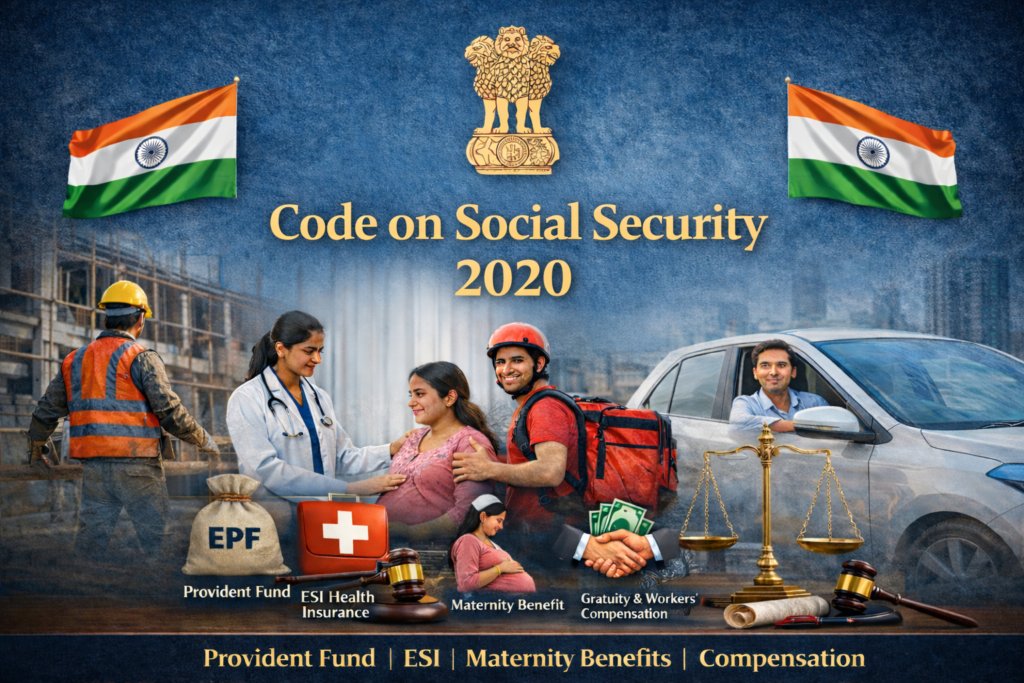
The Code on Social Security, 2020 is one of the four major labour law reforms introduced by the Government of India. This Code subsumes and simplifies nine different social security laws into one unified legislation to provide social protection and financial security to workers.
It provides provisions relating to EPFO, ESIC, Gratuity, Maternity Benefit, and Employee’s Compensation. The Code expands social security benefits not only for employees in organised sectors but also for unorganised workers, gig workers, and platform workers such as delivery partners and cab drivers.
Earlier Laws Replaced by the Code
The Social Security Code consolidates the following nine labour laws:
- Employees’ Provident Funds and Miscellaneous Provisions Act, 1952
- Employees’ State Insurance Act, 1948
- Payment of Gratuity Act, 1972
- Maternity Benefit Act, 1961
- Employees’ Compensation Act, 1923
- Employment Exchanges (Compulsory Notification of Vacancies) Act, 1959
- Cine Workers Welfare Fund Act, 1981
- Building and Other Construction Workers Welfare Cess Act, 1996
- Unorganised Workers’ Social Security Act, 2008
By merging these laws, the Code creates a single framework for social security benefits in India.
Objectives of the Social Security Code
The Code aims to:
- Provide financial security and welfare benefits to workers
• Extend social security to unorganised sector workers
• Include gig workers and platform workers under social protection
• Simplify compliance for employers
• Promote labour welfare and economic stability
1. Coverage of Workers
The Code covers a wide range of workers/employees, including:
- Employees in organised sector companies
• Workers in factories, offices, shops, and establishments
• Unorganised workers
• Gig workers (such as food delivery workers/partners)
• Platform workers (such as ride-sharing drivers)
• Construction workers
• Contract labour
This is one of the most important reforms, as earlier social security laws mostly covered only the organised sector.
2. Employees’ Provident Fund (EPF)
The Employees’ Provident Fund is a retirement saving scheme continued under the Code and administered by the Employees’ Provident Fund Organisation (EPFO).
Applicability
The EPF provisions apply to all establishments employing 20 or more employees. Under the new Code, the earlier restriction limiting EPF coverage to certain “Scheduled Employments” has removed.
EPF Schemes under new Code
The Central Government may frame three types of schemes under the EPF system:
- Employees’ Provident Fund Scheme – Provides retirement savings for employees through regular contributions.
- Employees’ Pension Scheme – Provides pension benefits after retirement or in cases of permanent disability.
- Employees’ Deposit Linked Insurance Scheme (EDLI) – Provides life insurance benefits to employees.
Contribution
Both the employer and the employee must contribute to the Provident Fund.
Typically:
- Employee contribution – 10% of wages
• Employer contribution – 10% of wages, equal to the employee’s contribution.
If an employee voluntarily contributes more than the prescribed percentage, the employer is not required to match the additional contribution.
The EPF scheme helps employees build long-term retirement saving and financial security after their working life.
3. Employees’ State Insurance (ESI)
The Employees’ State Insurance (ESI) scheme provides health insurance and social security benefits to workers. It continues under the Code on Social Security, 2020 and is administered by the Employees’ State Insurance Corporation (ESIC).
Applicability
The ESI scheme generally applies to establishments employing 10 or more employees, except seasonal factories. It also applies to establishments involved in hazardous or life-threatening activities, even if they employ only one worker. The provisions also cover certain sectors such as mines, ports, and areas where dock work is carried out.
Contributions
The employer is responsible for depositing both the employer’s and the employee’s contributions for every employee covered under the scheme.
Family Coverage
Employees covered under the ESI scheme are entitled to several benefits, including:
- Medical Benefit – Medical treatment for the insured employee and their family.
- Sickness Benefit – Periodical payment to the employee during illness.
- Maternity Benefit – Financial support to women employees during pregnancy, childbirth, or miscarriage.
- Disablement Benefit – Compensation if an employee suffers disability due to a work-related injury.
- Dependants’ Benefit – Periodical payments to the family of an employee who dies due to an employment injury.
- Funeral Expenses – Payment to cover funeral expenses of the deceased insured employee.
The ESI scheme provides healthcare protection and financial support to workers and their families, ensuring security in cases of illness, injury, maternity, or death arising from employment.
4. Gratuity Benefits
Gratuity is a financial benefit paid by an employer to an employee as a reward for long and continuous service. The provisions relating to gratuity are continued under the Code on Social Security, 2020.
Eligibility for Gratuity
An employee becomes eligible to receive gratuity after completing at least five years of continuous service with the employer. Gratuity becomes payable when the employment ends due to:
- Superannuation or retirement
• Resignation from employment
• Death of the employee (paid to the nominee or family members)
• Disablement due to accident or disease
• Any other event notified by the Central Government
Fixed-Term Employees
A significant reform under the Code is that fixed-term employees are also entitled to gratuity. In such cases, gratuity must be paid after completion of one year of service when the fixed-term contract ends.
Calculation of Gratuity
Gratuity is calculated at the rate of 15 days’ wages for every completed year of service, subject to the maximum limit notified by the Central Government.
Time Limit for Payment
The employer must pay the gratuity amount within 30 days from the date it becomes payable.
Nomination Requirement
Employees who have completed one year of service must submit a nomination in the prescribed manner. This ensures that gratuity can be paid to the nominated person or family members in case of the employee’s death.
Gratuity provides financial security to employees after long service and supports their financial stability after retirement or separation from employment.
5. Maternity Benefits
Women employees are entitled to maternity benefits under the Code, which aims to protect the health, dignity, and employment rights of women during pregnancy and childbirth.
Eligibility
A woman employee becomes eligible for maternity benefits if she has worked for at least 80 days during the 12 months preceding the expected date of delivery.
Essential Provisions under the Code
- Paid Maternity Leave: Eligible women employees are entitled to 26 weeks of paid maternity leave.
- Protection from Dismissal: An employer cannot dismiss or discharge a woman employee while she is on maternity leave or absent from work in accordance with the law.
- Medical Bonus: Employers must pay a medical bonus of ₹3,500 to every eligible woman employee if pre-natal and post-natal care is not provided by the employer.
- Leave in Special Cases:
- 6 weeks leave in case of miscarriage or medical termination of pregnancy.
- 2 weeks leave in case of tubectomy operation.
- Nursing Breaks: After returning to work, a woman employee is entitled to two nursing breaks in addition to regular rest intervals until the child reaches 15 months of age.
- Crèche Facility: Establishments employing 50 or more employees must provide a crèche facility for children below six years of age. Employers may also use shared crèche facilities provided by the government, private organisations, NGOs, or a group of establishments.
These provisions support women’s health, child care, and job security, while encouraging greater participation of women in the workforce.
6. Employees’ Compensation
Under the Code, employers are required to provide compensation to employees who suffer injury, disability, or death due to accidents arising out of and in the course of employment.
Situations Where Compensation is Payable
An employer must pay compensation if an employee suffers:
- Workplace injury
• Occupational disease caused by the nature of employment
• Permanent or temporary disability due to employment
• Death resulting from a work-related accident
Accidents During Travel
An accident occurring while an employee is travelling between their residence and workplace, or vice versa, may also be treated as an accident arising out of and in the course of employment.
Payment of Compensation
In cases where the employee dies or the dependants are minors, the employer must deposit the compensation amount with the competent authority, which will then distribute it to the eligible dependants.
These provisions ensure financial protection and support for employees and their families in cases of work-related injuries, disabilities, or death.
7. Social Security for Gig and Platform Workers
One of the key reforms introduced under the Code is the recognition and inclusion of gig workers and platform workers within the social security framework for the first time.
Who are Gig and Platform Workers?
These workers generally provide services through digital platforms or on a task-based basis. Examples include:
- Food delivery partners
• Ride-sharing drivers
• Online service providers and freelancers
Under the Code, the Central Government is the appropriate authority for matters related to gig and platform workers.
Welfare Schemes
The government may introduce special social security schemes for these workers. These schemes may cover benefits such as:
- Life and disability insurance
• Health and maternity benefits
• Old-age protection
• Other welfare measures
Contribution by Aggregators
Digital platforms or aggregators are required to contribute to social security funds for gig and platform workers. The contribution must be:
- Between 1% and 2% of the aggregator’s annual turnover, and
• Not exceeding 5% of the total amount paid or payable to gig and platform workers.
Funding Sources
Social security schemes for gig and platform workers may be funded through contributions from:
- Central Government
• State Governments
• Aggregator platforms or digital service companies
This reform is an important step toward providing social security protection and welfare benefits to workers in the rapidly growing digital and gig economy.
8. Building and Other Construction Workers (BOCW)
The Code includes provisions for the welfare and social security of building and construction workers.
Applicability
Under the Code, building and other construction work does not include:
- Construction work related to a factory or mine.
- Construction work where less than 10 workers were employed during the preceding 12 months.
- Construction carried out for personal residential use by an individual or group of individuals where the total cost does not exceed ₹50 lakh (or such higher amount as may be notified by the government) and the number of workers employed is within the limit prescribed by the appropriate government.
Welfare Cess for Construction Workers
Employers undertaking construction activities must pay a cess ranging from 1% to 2% of the total construction cost. This cess is used to fund social security and welfare benefits for construction workers.
Payment of Cess
The employer must pay the cess within 60 days after completion of the construction work, or within such period as may be notified by the Central Government. The payment is made based on self-assessment of the construction cost, after adjusting any advance cess already paid.
9. Registration of Workers
Workers must be registered on government portals to receive social security benefits.
The government may create online registration systems where workers can:
- Register themselves
• Update their employment details
• Access welfare schemes
This system helps ensure that benefits reach workers efficiently.
10. Employment Exchanges / Career Centres
The Code also provides for reporting job vacancies to employment exchanges or career centres.
Reporting of Vacancies
The appropriate government may require employers to report job vacancies to a designated career centre before filling them.
Procedure
The government may prescribe the form and method (electronic or otherwise) for reporting vacancies and submitting returns to the career centres.
However, reporting a vacancy does not make it mandatory for the employer to recruit candidates through the career centre. It is only a requirement to inform the government about available employment opportunities.
11. Social Security Organisations
The Code continues several social security institutions responsible for implementing welfare schemes.
These include:
- Employees’ Provident Fund Organisation
• Employees’ State Insurance Corporation
• Welfare Boards for specific sectors such as construction workers
These organisations manage funds, benefits, and welfare programs for workers.
12. Employer Compliance Requirements
Employers must comply with several obligations under the Social Security Code.
These include:
- Registering their establishment under the Code
• Making contributions to EPF and ESI schemes
• Maintaining employee records
• Filing required returns with authorities
• Ensuring workers receive applicable benefits
Failure to comply may result in penalties, fines, or legal action.
13. Penalties
Under the Code on Social Security, 2020, strict penalties are imposed on employers who fail to comply with social security obligations.
If an employer fails to pay required contributions or gratuity, the following actions may be taken:
- Heavy fines and interest on the unpaid amount.
• Imprisonment, which may extend from one to three years in case of repeated offences.
• Recovery proceedings may be initiated by the authorities to recover the outstanding dues.
However, such recovery proceedings must generally be initiated within five years from the date the amount became due.
These penalties are intended to ensure that employers fulfil their legal obligations and protect the social security rights of employees.
Closing Insight
The Code on Social Security, 2020 represents a significant reform in India’s labour law framework by establishing a more comprehensive and inclusive social security system for workers. Unlike earlier laws that primarily focused on employees in the organised sector, this Code expands coverage to include unorganised workers, gig workers, and platform workers, thereby addressing the needs of the modern workforce and emerging employment models. The Code ensures that workers receive essential social security benefits such as provident fund savings for retirement, health insurance through employee state insurance schemes, maternity protection for women employees, compensation for workplace injuries or employment-related accidents, and gratuity or retirement benefits after long-term service. By consolidating multiple social security laws into a single framework, the Code simplifies compliance for employers while strengthening financial protection and welfare for workers. Overall, the Code on Social Security promotes worker welfare, financial security, and inclusive economic growth, contributing to a more balanced and sustainable labour ecosystem in India.
At The Barrister Talk,
Information and facilitation services are provided by seasoned legal professionals with proven expertise across complex legal and regulatory matters. We offer more than advice—we provide clear strategy, sound judgment, and dependable representation tailored to each client’s objectives.
Every engagement is approached with precision, confidentiality, and professional integrity. Whether advising individuals, founders, or enterprises, we combine rigorous legal analysis with practical insight, ensuring outcomes that are both legally sound and commercially sensible.
With The Barrister Talk, you gain access to trusted legal minds committed to protecting your interests and guiding you with confidence.