
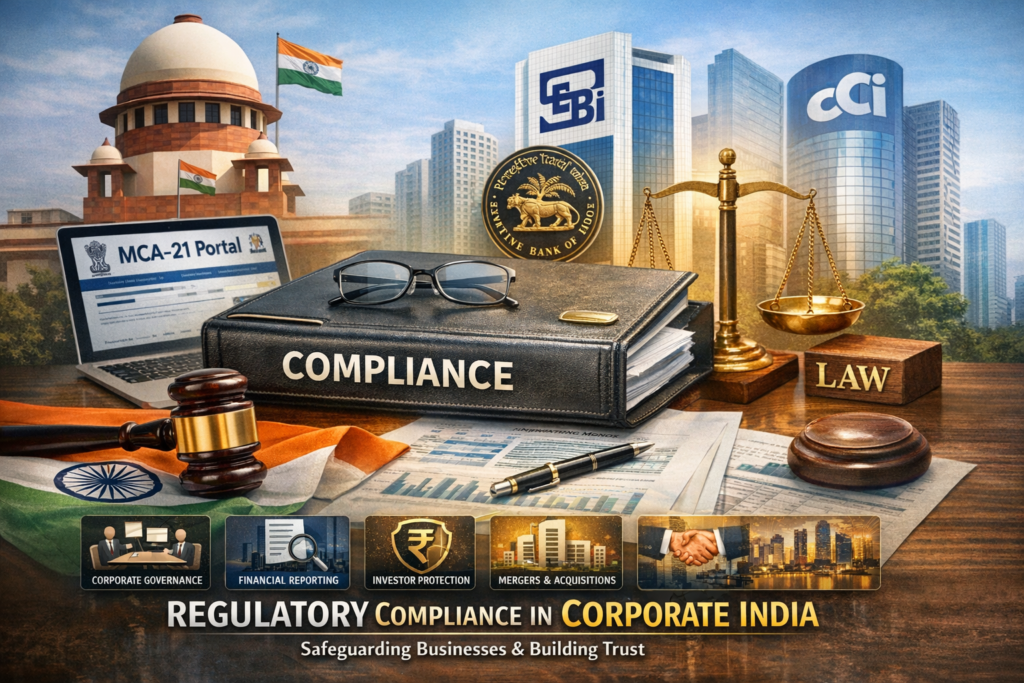
Regulatory compliance means companies in India must follow all the laws, rules, and guidelines made by the government and official regulators. It is like obeying traffic rules while driving a business – if you follow them, you stay safe and grow smoothly. If you break them, you face fines, court cases, or even shutdowns. In simple words, it keeps businesses honest, protects investors, workers, and the public, and builds trust in the market.
In India’s corporate world (companies registered under the Companies Act), compliance is not optional but mandatory. It covers everything from how directors run the company to how money is raised or how accounts are reported. The Supreme Court of India has time and again explained and strengthened these rules through its real time judgments.
Why Regulatory Compliance Matters for Companies
Compliance protects everyone:
- It safeguards investors from fraud.
- It helps companies avoid heavy penalties and loss of reputation.
- It makes sure the company can raise funds, merge, or expand without legal hurdles.
- It promotes good corporate governance – fair and transparent management.
Legal Frameworks and Major Regulatory Bodies
India has a clear framework. Here are the main ones every company must follow:
- Companies Act, 2013 (administered by the Ministry of Corporate Affairs – MCA) – This is the “constitution” for all companies. It covers incorporation, board meetings, financial statements, director duties, mergers & acquisition, and annual filings.
- SEBI Act, 1992 and SEBI (Listing Obligations and Disclosure Requirements) Regulations, 2015 (LODR) (administered by Securities and Exchange Board of India – SEBI) – SEBI regulates listed companies and anyone raising money from the public. Rules therein cover disclosures, insider trading, takeovers, and investor protection.
- Foreign Exchange Management Act, 1999 (FEMA) (administered by Reserve Bank of India – RBI) Controls foreign investment, external commercial borrowings, and cross-border payments.
- Competition Act, 2002 (administered by Competition Commission of India – CCI) Prevents unfair monopolies and regulates big mergers.
- Other Important Laws
- Goods and Services Tax (GST) laws
- Labour codes and environmental laws
- Sector-specific rules (e.g., RBI for banks and NBFCs)
These regulators issue circulars and notifications from time to time. Companies must keep updating their systems to stay compliant.
Main Areas (Parts) of Regulatory Compliance
Compliance touches every part of a company’s operation. Here are the essentials features of regulatory compliances in India:
- Corporate Governance and Board Duties – Directors must act honestly, attend board meetings, avoid conflicts of interest, and protect minority shareholders. Independent directors and audit committees are compulsory for bigger companies. Proper minutes of meetings and related-party transaction approvals are mandatory.
- Financial Reporting and Disclosures – Every company must file accurate annual financial statements, annual returns, and auditor reports with MCA on time. Listed companies must also follow SEBI’s strict disclosure rules on the stock exchange.
- Fundraising and Securities Compliance – If a company wants to raise money from the public (even through debentures), it must issue a prospectus, apply for listing on a stock exchange, and follow SEBI rules. Private placement has strict limits.
- Foreign Investment and FEMA Compliance – Foreign money coming in or going out needs RBI approval or reporting. Valuation by registered experts and timely filings are compulsory.
- Mergers, Acquisitions, and Competition – Big deals need CCI approval to ensure no monopoly is created. Listed companies also need SEBI approval for takeovers.
- Compliance Officer and Internal Systems – Every listed company must appoint a Company Secretary as Compliance Officer. This person ensures all filings are done and reports any violations to the board.
Companies usually maintain a “compliance calendar” and use software to track deadlines. Regular internal audits and training of staff are best practices.
Landmark Judgments on Regulatory Compliances
The Hon’ble Supreme Court has given clear directions in its three landmark judgments. Here are three important cases that show what compliance really means in practice:
Sahara India Real Estate Corporation Ltd. & Others v. SEBI (Civil Appeal No. 9813 of 2011, Judgment dated 31 August 2012)
Sahara companies raised more than ₹17,000 crore from nearly 3 crore investors through Optionally Fully Convertible Debentures (OFCDs) claiming it was a “private placement”. They did not file a prospectus, did not apply for listing on any stock exchange, and did not follow public issue rules. The Hon’ble Supreme Court held that when securities are offered to more than 50 persons, it becomes a “public offer” under Section 67(3) of the Companies Act. Listing under Section 73 is mandatory. The Court clearly said SEBI has full power under Sections 11, 11A, and 11B of the SEBI Act to investigate and order refunds even for unlisted companies when investor interests are involved.
Final Order: Sahara had to refund nearly ₹17,400 crore with 15% interest within three months. This judgment is a landmark because it closed loopholes and made it crystal clear that companies cannot raise public money without full regulatory compliance and disclosure.
Tata Consultancy Services Limited v. Cyrus Investments Pvt. Ltd. (Judgment dated 2021)
After Cyrus Mistry was removed as Chairman of Tata Sons, his companies alleged oppression and mismanagement. The Hon’ble Supreme Court upheld the removal and ruled in favour of Tata group. The Court said courts will not interfere in the commercial decisions of the board unless there is clear violation of law or proven oppression of minority shareholders. It strongly supported the role of independent directors and proper corporate governance processes under the Companies Act, 2013.
This judgment reminds companies that following board procedures, maintaining transparency, and respecting majority decisions (when done lawfully) is the core of regulatory compliance in governance.
Prakash Gupta v. Securities and Exchange Board of India (Judgment dated 20 May 2021)
This case was about compounding (settling) offences under the SEBI Act. The Hon’ble Supreme Court ruled that while SEBI’s formal consent is not mandatory for compounding, the views and opinion of SEBI must be obtained and given very high respect by courts and tribunals. The Court said offences that affect the public or the securities market should not be lightly compounded.
This judgment strengthens enforcement of compliance because it shows that regulators’ expert view carries heavy weight when penalties or settlements are considered. Companies now know that violating SEBI rules can lead to serious consequences even if they later try to settle.
These landmark judgments prove that the Supreme Court treats regulatory compliance as non-negotiable for protecting investors and maintaining market confidence as to public interest and the integrity of India’s financial system.
Consequences of Non-Compliance
Breaking rules attracts strict action:
- Monetary penalties (from lakhs to crores).
- Imprisonment in serious fraud cases.
- Director disqualification for up to 5 years (under Section 164(2) of Companies Act for not filing accounts).
- Company barred from raising funds or trading on stock exchanges/market.
- Civil and criminal liability for directors and officers.
The law treats these violations seriously because they harm investors and the economy. The
How Companies Can Stay Compliant – Practical Steps
- Appoint a qualified Company Secretary or experienced legal professional as Compliance Officer.
- Maintain proper records and file all documents on time through MCA21(V3) portal (https://www.mca.gov.in/) or stock exchange platforms i.e. Zerodha, Groww, Upstox, Angel one, ICICI Direct etc.
- Conduct regular internal and secretarial audits.
- Train directors and employees on latest rules.
- Use technology for tracking deadlines.
- Seek expert legal advice before big decisions like fundraising or mergers.
What is MCA21 Portal ?
The MCA 21 portal (https://www.mca.gov.in/) is is the official online platform of the Ministry of Corporate Affairs (MCA), Government of India. It is a complete digital system that automates all company and LLP-related work so that businesses can easily follow the law without visiting any government office.
It is like a one-stop online office for all corporate compliances. In simple words:-
- Incorporate a new Private Limited Company, One Person Company, LLP, (using SPICe+).
- File all mandatory forms (AOC-4 for financial statements, MGT-7 for annual return, DIR-3 KYC, MSME-1, etc.).
- Appoint/remove directors, change registered office, increase capital.
- View master data and public documents of any company (free or paid).
- Pay fees and get Digital Signature Certificate (DSC) associated.
- Get approvals for name change, merger, strike-off, etc.
- Track status of your filings in real time.
- It saves time, reduces paperwork, and makes everything transparent.
Advisory Note
Regulatory compliance is not just paperwork – it is the foundation of a healthy corporate world in India. By following the Companies Act, SEBI rules, FEMA, and other laws, companies grow safely and contribute to India’s economy. The Supreme Court’s clear rulings, especially in the Sahara case, Tata-Mistry case, and Prakash Gupta case, have made the law stronger and easier to understand. Every director, officer, and company must treat compliance as a daily responsibility, not a one-time task.
If every Indian company follows these rules honestly, investors will trust the market more, and India will continue to shine as a preferred business destination. Stay compliant, stay protected, and grow with confidence.
At The Barrister Talk,
Information and facilitation services are provided by seasoned legal professionals with proven expertise across complex legal and regulatory matters. We offer more than advice—we provide clear strategy, sound judgment, and dependable representation tailored to each client’s objectives.
Every engagement is approached with precision, confidentiality, and professional integrity. Whether advising individuals, founders, or enterprises, we combine rigorous legal analysis with practical insight, ensuring outcomes that are both legally sound and commercially sensible.
With The Barrister Talk, you gain access to trusted legal minds committed to protecting your interests and guiding you with confidence.