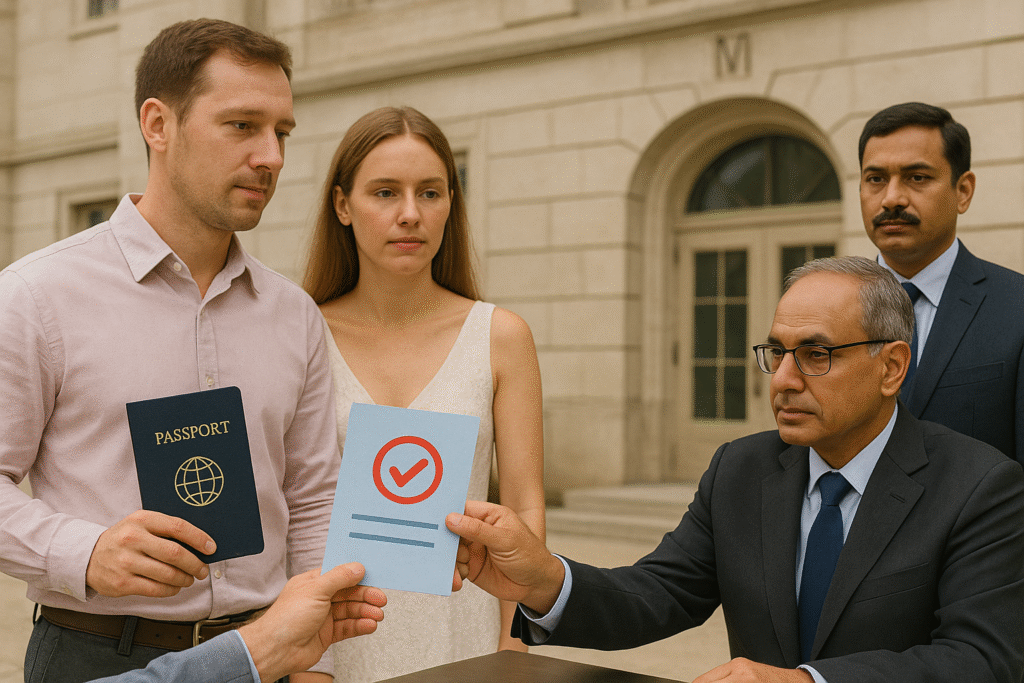

A detailed, practical, and legally sound guide for foreign nationals
A spouse visa rejection based on religious conversion done only for marriage can feel overwhelming and unfair, especially for international and cross-border couples connected to India. However, it is important to understand this clearly: such a rejection does not mean your relationship is false, and it does not mean religious conversion is illegal. In most cases, immigration authorities are not questioning your love or intentions—they are only concerned about whether the marriage is legally valid under Indian law. The good news is that this type of rejection is usually fixable. With the correct legal approach, proper marriage registration, and clear documentation, many couples successfully resolve the issue and move forward without further problems. This article explains everything in simple, easy-to-understand words—what caused the rejection, how it can be legally corrected step by step, and how to avoid a second refusal—so that international and foreign clients can confidently understand their options and take the right next step.
Understanding the Real Reason for Rejection (Most Important Step)
The first and most important step after a spouse visa rejection is to clearly understand why it happened. Many couples misunderstand this part, which leads to repeated mistakes.
What the rejection is not about: it is not because religious conversion is illegal in India, not because interfaith marriages are banned, and not because foreign authorities judge or question religious beliefs.
What the rejection is about: foreign immigration authorities, including USCIS, mainly check whether the marriage is legally valid under Indian law, whether the conversion looks genuine or only a formality, and whether the marriage stands on a strong legal foundation. If the conversion appears to have been done only to meet marriage requirements, authorities may treat the marriage as legally weak or defective, even when the relationship itself is real.
Cure the Marriage Legally – The Core and Most Effective Remedy
The strongest and safest way to fix a spouse visa rejection based on religious conversion is to register the marriage under the Special Marriage Act, 1954. This law is a civil and religion-neutral law, which means no religious conversion is required at all, and the validity of the marriage becomes independent of faith. Once a marriage is registered under this Act, it removes all doubts about sham or paper conversion and marriages based only on religious ceremonies. Importantly, this method is widely accepted by Indian courts, foreign immigration authorities, embassies, and consulates, making it highly reliable for international cases. Even if the couple already had a religious marriage (such as Arya Samaj or church marriage), they can re-register the same marriage under the Special Marriage Act to legally cure the defect. While this process involves some formal steps, documents, and a short waiting period (usually 30–45 days in India), it completely removes the root legal weakness, neutralises all conversion-related objections, and gives the marriage strong international credibility. Despite minor inconvenience, this is the most decisive and effective remedy to avoid further visa problems.
Prepare a Proper Legal Explanation (“Cure File”)
Fixing the marriage legally is very important, but that alone is not enough. Immigration authorities must also be clearly and honestly told what happened and how it has now been corrected. This is done through a Legal Cure File, which is a simple, well-organised explanation submitted with the new visa application to show transparency, honesty, and legal clarity.
A Legal Cure File should include three basic parts. First, a clear cover letter explaining in simple words why religious conversion happened at the time of marriage, why the marriage was later registered under the Special Marriage Act, and clearly stating that there was no fraud, misrepresentation, or bad intention. Second, affidavits from both spouses confirming that the relationship was voluntary, the marriage is genuine, and the couple has continued to live as husband and wife. Third, a brief legal reference to Law Commission of India Report No. 235 (2010) to explain that Indian law looks at intention and conduct, not just certificates or rituals, and that substance matters more than form.
This approach shows legal maturity and honesty, not defensiveness. It builds credibility, reduces suspicion, and aligns with Indian legal principles. The only caution is that the explanation must be carefully and clearly drafted, because vague or poorly written statements can create confusion instead of resolving it.
Re-file the Spouse Visa Petition (Fresh Filing, Not Emotional Appeal)
Once the marriage has been legally corrected and the Legal Cure File is ready, the next step is to file a fresh spouse visa application, not an emotional appeal. The correct approach is to start a new petition, honestly disclose the earlier rejection, and clearly show how the problem has now been fixed. The new filing should include the Special Marriage Act marriage certificate, strong proof of the genuine relationship (such as photos, messages, and travel records), and the Legal Cure File explaining the correction.
It is very important never to hide or ignore a previous rejection. Immigration authorities can see past records, and hiding them almost always leads to a second and more serious refusal. The benefit of re-filing correctly is that the case is reviewed afresh on legally corrected facts, giving a strong chance of approval once the defect is cured. The downside is that re-filing takes time, money, and patience, but it is the safest and most effective path forward
Strengthen Overall Immigration Compliance
Even after fixing the marriage legally, many spouse visa cases still fail because of technical immigration problems, so these issues must be handled at the same time. It is important to ensure that the marriage has proper civil documentation, the sponsoring spouse meets the financial requirements, there is a clear plan showing where the couple will live, and a realistic intention to live together as husband and wife. Taking care of these points together helps make sure the application is not rejected again for technical reasons, even after the main legal issue with the marriage has been corrected.
Remedies That Usually Do NOT Work Alone (Common Mistakes)
Many couples make the mistake of taking steps that do not actually fix the core legal problem. Filing appeals without correcting the legal validity of the marriage, submitting only conversion certificates, arguing religion or faith emotionally, or re-filing without proper civil marriage registration usually does not work. These approaches often lead to repeat rejections, sometimes with stronger and more damaging remarks from immigration authorities.
Pros and Cons Summary
The cure process is legally strong, widely accepted internationally, removes long-term immigration risk, and usually acts as a one-time permanent solution. The disadvantages are that it takes extra time, involves procedural steps, and may require some short-term expense. However, these minor drawbacks are far outweighed by the long-term benefit of legal certainty and peace of mind, making the cure process the most sensible and effective option.
Conclusion
A spouse visa rejection based on religious conversion for marriage can usually be fixed. The real problem is not religion or faith, but whether the marriage is legally valid. The safest and most reliable solution is to have the marriage registered under the Special Marriage Act, which removes all doubts about conversion. Once this legal issue is properly cured, filing a fresh spouse visa application gives a strong and realistic chance of approval.
Legal Advice / Disclaimer
The information provided above is only for awareness and general guidance, so that individuals are informed, empowered, and protected from misunderstanding or misguidance. It is not a substitute for professional legal advice. Every case depends on its own facts, documents, and legal position, therefore it is strongly advised to consult and engage a qualified legal professional or immigration expert to handle the matter properly and avoid costly mistakes.
If you need guidance or have questions, feel free to ask or consult our qualified legal professionals or reach out for reliable assistance or personalized support.
Subscribe to stay updated with the latest legal developments, immigration rules, and practical guidance for foreign nationals.